The 2026 FIFA World Cup quarterfinals have never been just about soccer. Not this year. Not with the host nation’s president making phone calls to FIFA officials, threatening trade wars at NATO summits, and sitting in the same room as the prime minister of the country that just handed America its most lopsided World Cup exit in a generation.
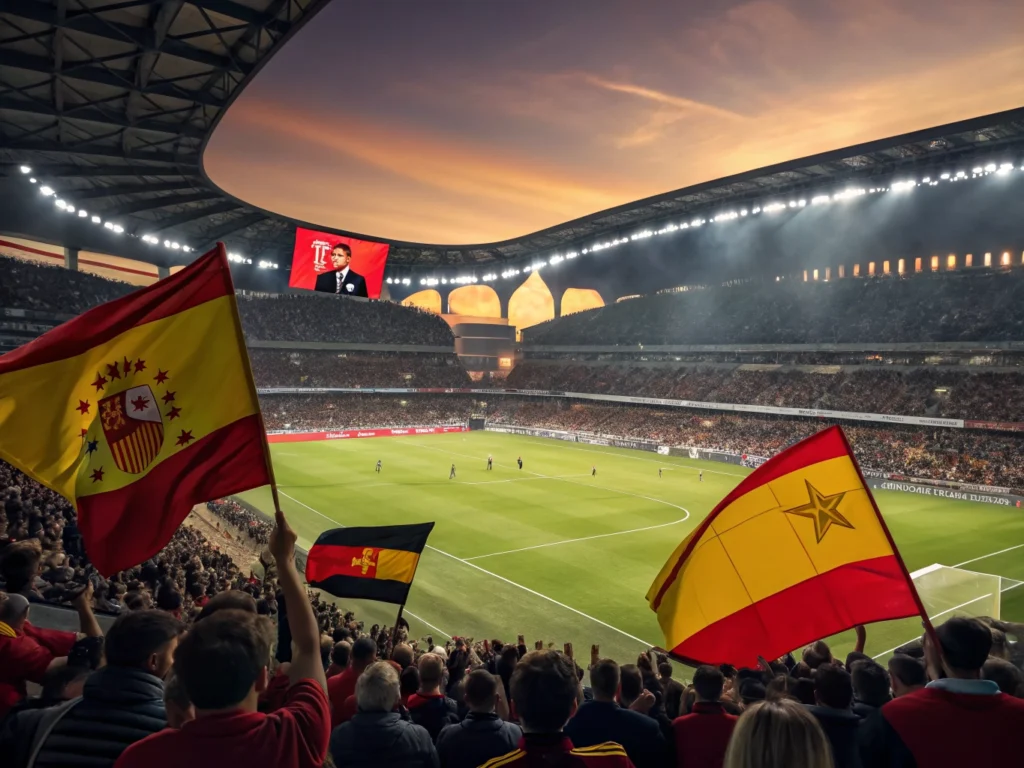
What is unfolding this week across Ankara, Turkey and Los Angeles, California is something the sports world rarely produces so cleanly: a storyline where the football pitch and the geopolitical stage are running the exact same drama simultaneously — and where Friday’s Spain vs. Belgium quarterfinal at SoFi Stadium has become something far bigger than a soccer match.
TRUMP, SPAIN, AND THE BLOWUP NOBODY IN ANKARA WAS READY FOR
European leaders arrived at the NATO summit in the Turkish capital this week hoping to project unity. What they got instead was a presidential eruption.
Standing alongside NATO Secretary-General Mark Rutte at a press conference in Ankara, President Trump called Spain “a wasted cause” and ordered Treasury Secretary Scott Bessent to cut off all trade with the country — including visits — over what he called Madrid’s failure to meet NATO’s defense spending targets and its refusal to support U.S. military action against Iran. Trump said, “Spain is a terrible partner in NATO. They don’t participate. They don’t pay. I don’t want anything to do with Spain,” adding, “Don’t even talk to them. They’re hopeless, bad people.”
It was the kind of language more suited to a reality television boardroom than to the headquarters of the world’s most consequential military alliance. And the context made it worse.
This was the second time Trump has instructed his Treasury Secretary to halt commerce with Spain over the country’s refusal to commit to NATO’s defense spending target of 5% of GDP — a demand that European officials broadly view as unrealistic. Spain’s Socialist leadership had also refused to allow the U.S. to use its airspace or military bases during the Iran war, a position that has put Madrid on a direct collision course with Washington for months.
NATO Secretary-General Rutte — who has spent considerable political capital trying to manage Trump’s frustrations while keeping the alliance intact — attempted to soften the blow at the press conference, noting that Spain had increased its defense spending to 2.1% of GDP, up from 1.4% in 2021, calling it a huge step. Trump was unmoved.
Trump’s remarks also overshadowed the carefully crafted pre-summit messaging that European NATO countries had stepped up military spending, with at least $50 billion in defense initiatives unveiled the day before. Instead of a summit that demonstrated Western cohesion, Ankara became a stage for Trump to publicly humiliate a NATO ally while simultaneously declaring the Iran ceasefire effectively over — a comment that sent Spanish bonds sliding and rattled equity markets worldwide.
To anyone watching objectively: this was not diplomacy. This was performance. And it had consequences.
BELGIUM SHOWED UP TO ANKARA WITH A 4-1 SCOREBOARD AND A PRIME MINISTER WITH A SENSE OF HUMOR
While Trump was torching diplomatic furniture in Turkey, Belgian Prime Minister Bart De Wever arrived at the NATO summit carrying something no other world leader had — the receipts from Monday night’s football match in Seattle.
Belgium dismantled the United States 4-1 at Lumen Field on July 6th in the World Cup Round of 16, with Charles De Ketelaere scoring twice and Romelu Lukaku sealing the result in stoppage time, sending the Red Devils to the quarterfinals and eliminating America from its own home tournament.
The game had been clouded by significant controversy before a ball was kicked. Trump personally called FIFA president Gianni Infantino to encourage a review of a red card issued to U.S. striker Folarin Balogun, which had triggered an automatic one-game suspension. In a highly unusual move, FIFA’s disciplinary panel delayed Balogun’s ban by a year — allowing him to play. Belgium’s football association formally protested his inclusion. None of it mattered. Balogun was a non-factor, and the U.S. was outclassed from the opening whistle.
Belgium did not let the moment pass quietly. After the final whistle, the Belgian national team’s official social media account posted a pointed reference to the Balogun controversy with a single-word message: Overturn this. The post required no further explanation.
De Wever arrived in Ankara carrying that energy — and deployed it masterfully. Speaking at the summit, De Wever called for NATO’s attention to remain on Ukraine rather than Iran, describing support for Kyiv as a clear red card for Putin — one that cannot be withdrawn. The red card reference was deliberate and unmistakable, drawing a direct line to the Balogun controversy and Belgium’s 4-1 victory.
He also came prepared with something Trump could not argue with on the defense spending front. De Wever noted that Belgium had increased its defense spending by 60 percent compared to the prior year — the largest increase of any EU member — while acknowledging they were starting from a low base.
And then there was the diplomatic subtext that nobody in the room could ignore. De Wever acknowledged that he and Trump had not spoken directly at the summit about the football match. He said they were not at the same table so they did not speak to each other much — before adding that he was genuinely worried the defeat had affected Trump’s mood at the summit, noting that Trump has a reputation for reacting grumpily to things he does not like and that he thinks the defeat hit him hard.
That is a sitting head of government, at a NATO summit, publicly wondering whether the American president’s geopolitical temperament was being influenced by a soccer score. That sentence alone tells you everything about the moment we are living in.
NOW BELGIUM MEETS SPAIN — AND THE POLITICS MAKE FRIDAY UNMISSABLE
Two days after Trump called Spain “hopeless” and “bad people” at a NATO press conference, Spain takes the field at SoFi Stadium in Los Angeles to face the country whose prime minister just used a football metaphor to troll the American president on the world stage.
You genuinely could not write this.
Spain arrive at the quarterfinal as the tournament’s most dominant side — five games played, five clean sheets kept, nine goals scored, and zero conceded. La Roja are on a 34-match unbeaten run, one short of their own national record, and enter Friday as the clear betting favorites. Their Round of 16 victory came against Portugal — ending, in the process, Cristiano Ronaldo’s World Cup career — on a stoppage-time header from substitute Mikel Merino.
Belgium counter with a tournament-high attacking output — they have scored more goals than any other quarterfinalist — but have conceded five times across their last three matches, revealing a defensive vulnerability that Spain’s technical precision is uniquely built to exploit.
This is only the third meeting between the two nations at a World Cup, with history perfectly split. Belgium beat Spain on penalties in the 1986 quarterfinals — the same stage as Friday’s match — and Spain won 2-1 in the 1990 group stage. Forty years later, the nations are back in the same bracket, carrying an entirely new layer of geopolitical baggage into the same stadium.
The on-field matchup is compelling on its own terms. Spain’s 17-year-old Lamine Yamal running at pace against Belgium’s aging defensive spine represents what analysts are calling the most significant individual mismatch of the quarterfinals. Belgium’s Charles De Ketelaere has been one of the tournament’s breakout stars, arriving with questions about his international quality and departing the round of 16 as his country’s leading scorer.
But the football almost feels secondary this week.
Spain’s players will take the field Friday representing a country whose prime minister Pedro Sanchez spent Tuesday in Ankara publicly reaffirming his nation’s commitment to NATO while Trump sat across the room calling his country “hopeless.” Belgium’s players arrive as the team that knocked out America, whose prime minister used a red card metaphor to needle the American president at a summit, and whose country has now out-diplomaced and out-played the United States in the same 48 hours.
THE BIGGER PICTURE: WHAT THIS WEEK ACTUALLY REVEALS
The convergence of the NATO summit and the World Cup quarterfinals is not coincidence — it is a reflection of where power, influence, and credibility actually live in 2026.
Trump arrived in Ankara as the leader of the world’s most powerful military alliance and used the stage to threaten trade sanctions against an ally, undermine the summit’s own messaging, and reignite a ceasefire dispute that rattled global markets. The primary diplomatic takeaway from the summit, according to a NATO official quoted in the room, was that Europe needed to accelerate the building of a more independent European NATO — a conclusion that directly benefits Spain and Belgium, not the United States.
Meanwhile, on a football pitch in Seattle, Belgium dismantled the American team despite a sitting president’s direct intervention in the sport’s governing body. The intervention was fruitless. The scoreboard was not.
There is an argument to be made that in the same 48-hour window, the United States lost influence on two different stages — one geopolitical, one sporting — and the countries stepping into that space happen to be playing each other on Friday in Los Angeles.
That is the game to watch. Not just for the football, which will be excellent, but for what it represents: two European nations who refused to be pushed around, meeting at the quarterfinal stage of a World Cup being hosted by a country whose president is learning, slowly and publicly, that leverage has limits.
Friday. SoFi Stadium. 3 p.m. ET.
Spain vs. Belgium. The most politically loaded match left in this tournament.