By Marcus Hart | The Urban News Journal
On April 29, 2026, the Supreme Court of the United States finished a job it has been working on for over a decade.
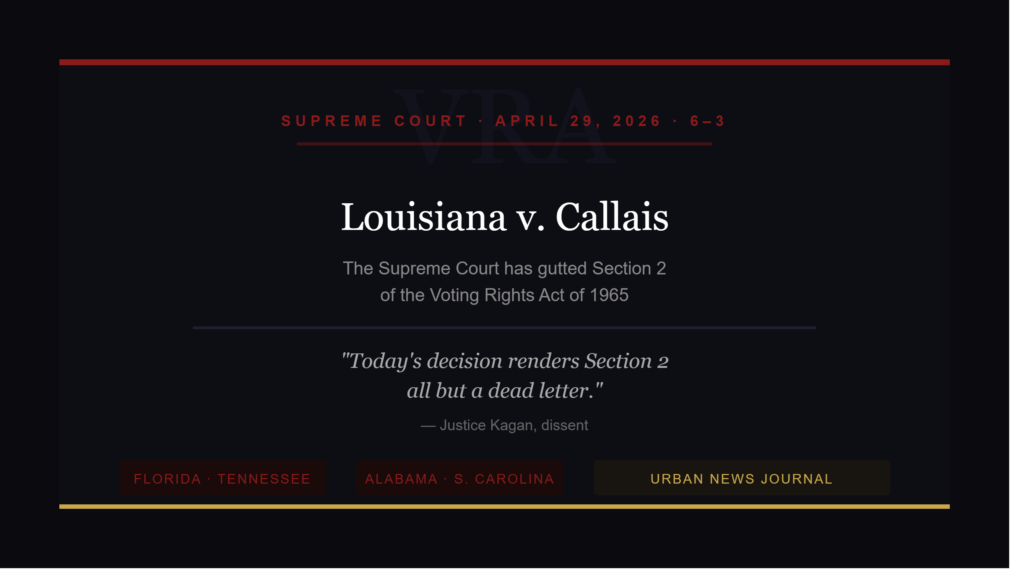
In a 6-3 ruling in Louisiana v. Callais, the Court weakened Section 2 of the Voting Rights Act to the point of inoperability. Justice Elena Kagan, writing in dissent, stated plainly that the decision renders Section 2 all but a dead letter. She was not being hyperbolic. She was being precise. Congress.gov
This column is not going to tell you to be outraged. Outrage is easy, it trends for 48 hours, and then the algorithm moves on to the next crisis while the structural damage compounds quietly in state legislatures across the South. Instead this piece is going to tell you exactly what happened, what it means on the ground, and what an independent, clear-eyed analysis says about what comes next.
What the Court Actually Did
To understand Callais you need to understand what Section 2 of the Voting Rights Act was designed to do. Passed in 1965 at the height of the Civil Rights Movement, Section 2 lets voters challenge redistricting maps that weaken the voting power of communities of color. For six decades it was the primary legal tool Black voters had to fight back when state legislatures drew lines designed to dilute their representation.
The Callais case began when Louisiana, under court order following the Supreme Court’s own ruling in Allen v. Milligan, drew a congressional map that included two majority-Black districts for the first time in the state’s history. The response was immediate — Florida passed new maps within hours of the Callais decision. Tennessee drew and passed new maps just days later. Congress.gov
In a 6-3 decision written by Justice Samuel Alito and joined by Chief Justice Roberts and Justices Thomas, Gorsuch, Kavanaugh, and Barrett, the Court ruled that Louisiana’s map was an unconstitutional racial gerrymander. The logic was circular in the way that only Supreme Court majorities can manage: the state drew majority-Black districts to comply with Section 2, but because the Court now holds that Section 2 did not actually require those districts, the state’s use of race had no compelling justification and therefore violated the Equal Protection Clause. NAACP Legal Defense Fund
Prior to Callais, a challenger was required to show that the design of a redistricting map resulted in minority vote dilution. After Callais, challengers must now show evidence that supports a strong inference that the state intentionally drew its districts to afford minority voters less opportunity because of their race. That shift from proving discriminatory result to proving discriminatory intent is not a technical adjustment. It is a near-total barrier. Proving what was in a state legislator’s mind is nearly impossible by design.
What Has Already Happened Since April 29
The speed of the response told you everything about how long states had been waiting for this ruling. Florida passed new maps within hours of the Callais decision. Tennessee drew and passed new maps just days later. Alabama has already passed legislation to push back the start of its primary election and is likely to redistrict. South Carolina’s legislature is in a special session to pass new maps. Congress.gov
Two challenges to maps in Mississippi and North Dakota were vacated and remanded by the Supreme Court on May 18, 2026, ordering lower courts to reconsider them in light of Callais. The dominoes are falling across the South and they are falling fast — timed, not coincidentally, to land before the November 2026 midterms. NAACP Legal Defense Fund
The practical effect is this: Black congressional representation in the South, which was already underweighted relative to population, is about to contract. The districts that produced Black members of Congress in Louisiana, Tennessee, Florida, and potentially Alabama will be redrawn out of existence or diluted to the point of irrelevance — all while the Court’s majority maintains with a straight face that no racial discrimination has occurred because no one wrote down that discrimination was the goal.
The Independent Analysis — Neither Outrage Nor Capitulation
The left-leaning press is covering Callais as the end of democracy. The right-leaning press is covering it as a corrective restoration of colorblind constitutionalism. Both framings are incomplete and neither is particularly useful to the communities most directly affected.
Here is what the independent analysis actually says.
The Callais decision is the culmination of a deliberate, decades-long legal strategy to dismantle the infrastructure of the Civil Rights Movement through the courts rather than the legislature. Justice Kagan’s dissent drew a clear line from Shelby County v. Holder in 2013, which eliminated the preclearance formula, through Brnovich v. Democratic National Committee in 2021, to Callais in 2026 — each decision narrowing the VRA’s reach until the instrument is functionally hollow. Reproductive Freedom for All®
That strategy was patient, methodical, and successful. Responding to it requires the same patience and methodology.
The progressive response — congressional legislation to restore Section 2 — is correct in principle and dead on arrival in the current Congress. The outrage cycle — marches, petitions, social media campaigns — has its place but has never, on its own, changed redistricting law. What has changed redistricting law, historically, is sustained local organizing around state legislative races, independent citizen redistricting commissions, and legal challenges at the state constitutional level rather than the federal level.
Several states have state constitutional provisions that provide stronger voting rights protections than the federal floor. Those provisions are now the primary battleground. Lawyers who were working federal Section 2 cases are pivoting to state constitutions. That is where the next decade of this fight will be won or lost.
What Comes Next — A Practical Framework
The independent voter — particularly the Black independent voter who is tired of being told that their salvation lies exclusively in one party’s hands — needs a practical framework that does not require federal courts to do what they have just conclusively demonstrated they will not do.
Three things matter more right now than any federal litigation strategy.
First, state legislative races in 2026 are more consequential than at any point since Reconstruction. The bodies that draw congressional maps are state legislatures. Flipping or holding state legislative chambers in Michigan, Wisconsin, Pennsylvania, and Georgia has direct, immediate impact on what the district maps look like after 2030 — which is the next redistricting cycle and the one that will govern representation for the following decade.
Second, independent redistricting commissions at the state level, where they exist or can be created through ballot initiative, remove the map-drawing power from legislators entirely. Colorado, California, Michigan, and Arizona have demonstrated that these commissions produce more representative maps than legislatures do. Every state that does not have one is a target for a ballot initiative campaign.
Third and most importantly: voter registration and turnout in the districts that remain. Callais eliminates some majority-Black districts. It does not eliminate Black voters. In districts where Black voters are a significant minority rather than a majority, organized bloc voting around shared economic and community interests — rather than reflexive party loyalty — can still produce accountable representation. That requires an organizing model built on local issues and local relationships, not national party infrastructure.
The Honest Bottom Line
The Voting Rights Act as it existed from 1965 to 2026 is functionally over. Justice Kagan said so in plain language. The states have responded in kind. Pretending otherwise is not advocacy — it is a coping mechanism.
What is not over is the fundamental project that the Voting Rights Act was designed to advance: equal political participation for Black Americans. That project predates Section 2, it has survived worse legal environments than this one, and it will continue through the mechanisms — state courts, local organizing, commission-based redistricting, and disciplined political participation — that do not require five Supreme Court justices to agree.
The Callais decision is a serious blow. It is not a final one. The question is whether the communities most affected respond with the kind of sustained, strategic, locally-grounded organizing that actually changes outcomes — or whether the moment is absorbed into the outrage cycle and forgotten by the time the next crisis arrives.
History suggests the answer depends entirely on what happens in the next six months in state capitols across the South.
Pay attention to those state capitols.
Marcus Hart is the founder of the Transform U Media Network and editor of The Urban News Journal. Follow independent coverage of politics, sports, and culture at urbannewsjournal.com. Subscribe to The Warrior Mandate at warriormandate.substack.com.