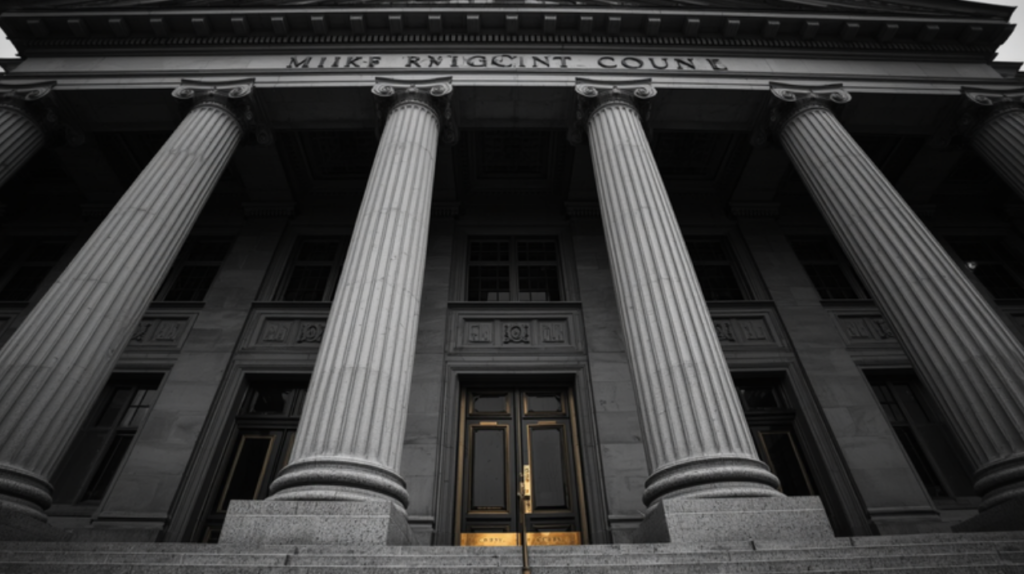
On July 8, a federal judge sentenced former Milwaukee County Circuit Judge Hannah Dugan to a $5,000 fine — no prison, no probation — for obstructing federal immigration agents who came to arrest a defendant inside the Milwaukee County Courthouse. U.S. District Judge Lynn Adelman, delivering the sentence, called it “a few minutes of conduct for someone who has dedicated her life to public service” and “a marked deviation from an otherwise law-abiding life.” Dugan had already resigned her judgeship in January amid threats of impeachment from Republican state lawmakers, and a jury had convicted her earlier this year of obstruction for confronting the ICE agents in a courthouse hallway and directing them away from the defendant, a man named Eduardo Flores-Ruiz who was appearing before her that day on a state battery charge.
I want to walk through this case the way UNJ approaches every story that lands on the fault line of our national politics: by holding every actor to the same standard, regardless of which side of the aisle claims them.
Start with what Dugan actually did. As a sitting judge, she has an obligation — arguably the single most important obligation attached to the office — to ensure that her courtroom operates as a space where the law is applied evenly and where litigants, including defendants with pending state charges, aren’t subject to competing jurisdictional interventions mid-proceeding. Whatever her motivation, and by all accounts her motivation was a belief that Flores-Ruiz deserved to have his state case resolved on its own terms rather than short-circuited by a federal arrest inside her courtroom, the method she chose was not itself lawful. A jury heard the evidence and convicted her. That verdict deserves respect, not dismissal, from anyone genuinely committed to the rule of law rather than committed only to defending people who share their politics.
Now the other side of the same coin, because accountability has to run in both directions or it isn’t accountability at all. Judge Adelman’s sentencing rationale — that this was a brief lapse inconsistent with an otherwise exemplary career of public service — is a standard that judges apply constantly to first-time offenders, and there’s nothing unusual or scandalous about applying it here. The commentary from some corners characterizing a no-prison sentence as a “miscarriage of justice” reveals more about the commentator’s politics than about the sentencing guidelines actually governing obstruction cases of this nature, most of which don’t carry mandatory incarceration for a first offense with no prior record. If a different judge, in a different courthouse, in a different political context, had made a similarly brief and non-violent error in judgment while otherwise serving with distinction, would the same critics be demanding prison time? UNJ readers know the honest answer to that question is usually no, and that inconsistency is exactly the kind of selective outrage this publication exists to call out on all sides.
Where I land, and where I think a genuinely independent reading of this case should land, is that both extremes get it wrong. The people arguing Dugan did nothing wrong are ignoring that a jury of her peers, presented with the facts, found her guilty. That’s not a technicality — it’s the system working as designed. But the people arguing this sentence represents some kind of two-tiered justice favoring a progressive judge are ignoring that judges — of every political persuasion — routinely receive lenient sentences for first offenses precisely because the system is built to weigh a full record, not just a single bad decision. That’s consistent, not corrupt.
What deserves more attention than it’s getting is the actual policy tension underneath this case: what should happen when federal immigration enforcement and state judicial proceedings collide inside the same building, on the same day, involving the same person? That’s not a hypothetical confined to Milwaukee. Courthouses in cities across the country have become flashpoints precisely because ICE has increasingly conducted arrests at or near state courthouses, and state court officials in multiple jurisdictions have pushed back, arguing it chills participation in the justice system by anyone with immigration concerns, including victims and witnesses who are in this country lawfully. Wisconsin lawmakers, on a bipartisan basis, could actually do something productive here: establish clear statutory protocols for how federal enforcement actions interface with active state court proceedings, so the next judge facing a similar moment has a lawful process to follow rather than having to improvise under pressure and risk a felony conviction for trying to protect the integrity of their courtroom.
That’s the solution-oriented path UNJ believes in. Not another round of partisan point-scoring over one former judge’s sentence, but a real conversation, in Madison, about writing rules that prevent this exact scenario from recurring — for judges, for defendants, and for the federal agents caught in the middle of a jurisdictional gray area nobody in Wisconsin state government has bothered to clarify.
Marcus Hart is a combat veteran, journalist, and founder of The Urban News Journal.