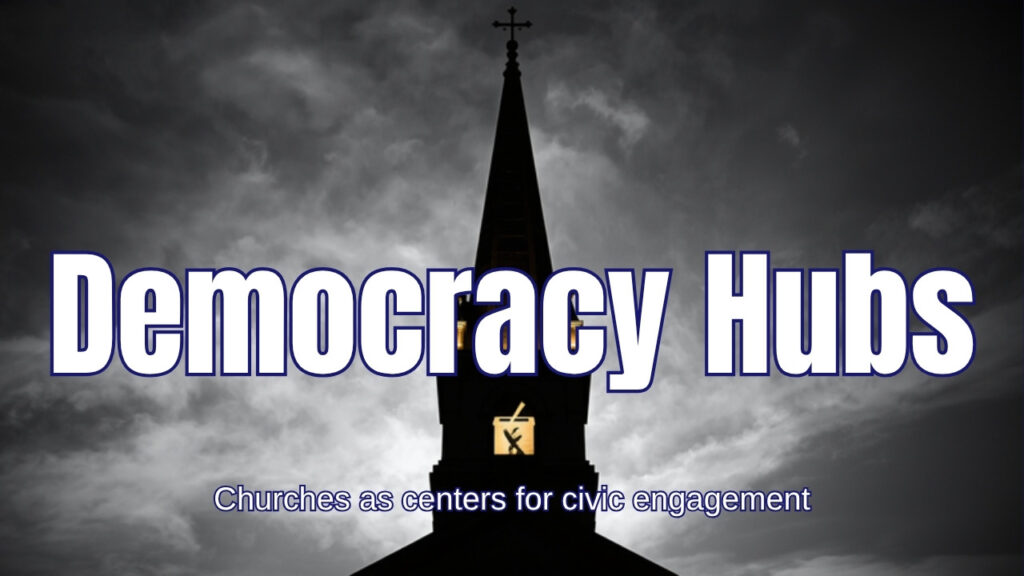
Four months out from the midterms, a coalition of Minnesota faith leaders unveiled a multistate initiative declaring that “our churches, our mosques, our synagogues, our places of worship will become democracy hubs” — spaces dedicated to voter access, civic education, and election protection ahead of November.
The leaders behind it framed it in explicitly theological terms: faith means nothing, one organizer said, if the values of life, liberty, and the pursuit of happiness aren’t actualized in the communities where people actually live.
I want to take that framing seriously, because it’s not a new idea dressed up in fresh language. It’s an old idea — arguably the oldest idea in Black American religious life. The Black church has never been a place that stayed out of public life, and pretending otherwise misreads its entire history. From the Underground Railroad routes that ran through congregations, to the church basements where the civil rights movement organized its Sunday strategy sessions, to the voter registration drives that turned “see you at church” into “see you at the polls” — the wall between faith and civic engagement in Black religious tradition has always been thinner than the wall some want it to be.
So when I see faith leaders declaring their buildings “democracy hubs” for 2026, my first reaction isn’t alarm. It’s recognition. This is what the Black church, in particular, has always understood its job to be: not just tending souls, but tending the conditions those souls have to survive in.
Here’s where I want to be careful, though, because UNJ doesn’t do partisan cheerleading regardless of which side is doing the organizing, and I’d write this same piece with the same concerns if a coalition of conservative-aligned congregations announced an identical initiative from the other direction.
Voter access, civic education, poll monitoring, ride-to-the-polls logistics, ballot literacy — all of that is squarely inside what a house of worship can do without crossing IRS lines around tax-exempt political activity, and it’s squarely inside what faith communities have always done well. Registering people, informing people, and protecting their access to the ballot box is nonpartisan by definition. Nobody should have a problem with a church helping its members exercise a right that belongs to them regardless of who they vote for.
Where it gets harder is the next step, the one that isn’t in this announcement but is always sitting right behind these initiatives: does “democracy hub” stay about access, or does it slide into candidate endorsement, slate cards distributed from the pulpit, or messaging that tells congregants who to vote for rather than just how. That line matters, and it matters regardless of which party benefits from crossing it. A 501(c)(3) that starts functioning as a campaign operation risks its exempt status and, more importantly, risks something less legally defined but just as costly — the credibility of the pulpit as a place above the partisan fray. Once a congregation is understood as a wing of one party’s coalition, it loses its ability to speak prophetically to that same party when it gets something wrong. That’s not a hypothetical. It’s happened to institutions on both the religious right and religious left over the last few decades, and it’s cost them exactly the moral authority they were trying to leverage.
My actual hope for initiatives like this one is that they hold the line at access and education, and resist the gravitational pull toward endorsement — not because faith should be silent on politics, but because faith’s power in the public square comes precisely from not being owned by either party. A church that gets people registered, informed, and safely to the polls regardless of how they’ll vote is doing something both sides should want more of. A church that becomes a get-out-the-vote machine for one party is just a PAC with a steeple, and it forfeits the very credibility that made the “democracy hub” framing compelling in the first place.
Four months is enough time to build the first version well. Whether these hubs stay in their lane between now and November will tell us a lot about whether this is a genuine renewal of the church’s civic tradition, or just the newest wrapper on the same old partisan machinery. I’m rooting for the former. I’ve seen too much of the latter to assume it by default.