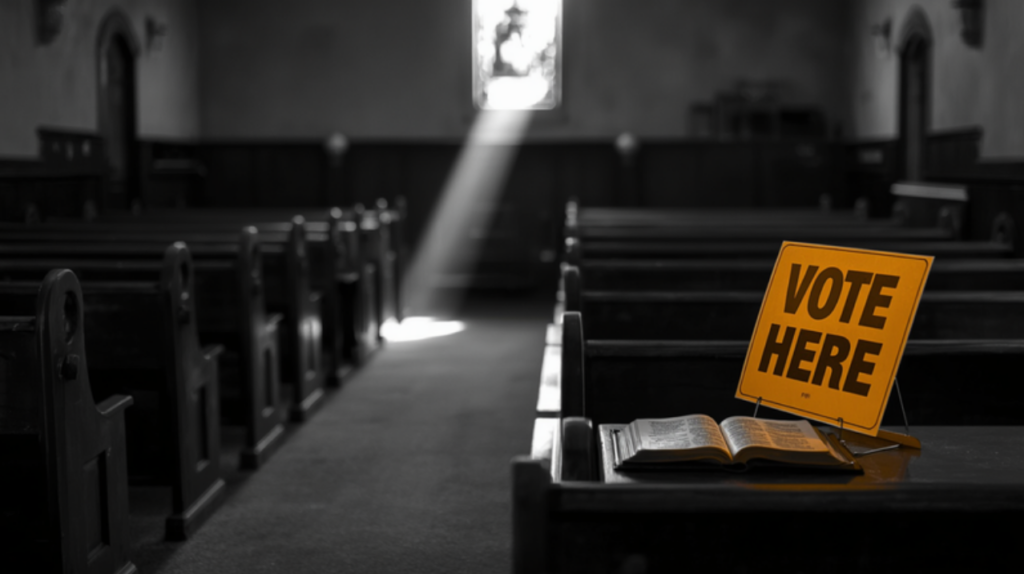
Faith leaders in Minnesota who made headlines last year for standing between federal immigration agents and members of their congregations are now turning their organizing energy toward a different arena: making sure eligible voters, in multiple states, actually get to cast a ballot in the 2026 midterms without obstruction. The initiative, still in its early organizing phase according to recent reporting, aims to coordinate faith communities across state lines to monitor polling access, support poll worker recruitment, and push back against what organizers describe as barriers disproportionately affecting elderly, disabled, and low-income voters.
I expect some readers’ first instinct, on both sides of the political spectrum, will be suspicion. Conservative readers may hear “faith leaders organizing around voting access” and assume this is a progressive get-out-the-vote operation wearing a clerical collar. Progressive readers, meanwhile, might assume any church-based political organizing is inherently suspect given the long, complicated history of churches and political machines in this country. Both instincts are worth examining honestly rather than dismissing outright, because both have some historical basis. But I’d ask readers in both camps to sit with a more basic question before deciding this initiative is illegitimate: is ensuring that a legally eligible voter can actually reach a ballot box a partisan act, or is it simply democracy functioning as designed?
Faith communities have occupied a specific and, historically, indispensable role in American civic life around elections that predates any current political alignment. Black churches served as literal organizing headquarters for voter registration drives throughout the civil rights era, often at direct physical risk to congregants and clergy alike. That history isn’t a Democratic Party talking point — it’s simply the historical record, and it’s one that conservative Black churches, evangelical congregations, and predominantly white denominations alike have all participated in at various points, usually when a specific community’s access to the ballot was under threat. What’s happening now, according to the reporting, follows that same lineage: a response to a perceived threat to access, not an attempt to deliver votes to a specific candidate or party.
Where I think this initiative needs to draw a hard, self-imposed line — and where UNJ will hold it accountable if it doesn’t — is between protecting access and campaigning for outcomes. There’s a meaningful and legally significant difference between a coalition of churches ensuring elderly congregants have rides to the polls and adequate poll worker staffing in their precincts, versus that same coalition using pulpit time to endorse specific candidates or ballot measures. The first is civic infrastructure work that strengthens democracy regardless of who benefits from higher turnout. The second crosses into territory that risks both a church’s tax-exempt status under the Johnson Amendment and, more importantly, the broader public trust that faith institutions should be earning through service rather than spending through partisan alignment.
This debate is unfolding against a backdrop that makes it more urgent, not less: faith leaders across denominations have expressed genuine alarm this year over a rise in attacks on houses of worship of multiple faiths, alongside inflammatory public statements targeting Islam specifically from prominent public figures. When religious communities feel under siege on one front, it’s not surprising that they’re organizing more assertively on other civic fronts where they still feel they have standing and credibility. That context matters for understanding the moment, even if it doesn’t resolve every question about where the line between civic engagement and political activity should sit.
I’ll offer my own view here as someone who holds faith as a genuine lens rather than a political weapon: churches, mosques, and synagogues showing up to make sure their neighbors can vote is not an act of partisan aggression. It’s closer to the oldest form of civic duty faith communities in this country have practiced, one that both major parties have relied on at different points in American history when it suited them. The solution isn’t for faith communities to retreat from civic life to avoid controversy. It’s for every congregation doing this work — regardless of denomination or regional politics — to hold itself to the access-not-advocacy standard publicly and transparently, so the work can’t be fairly dismissed as partisan cover.
Milwaukee’s own faith community, spanning Black Baptist churches on the north side to Catholic parishes serving the city’s Latino population to synagogues and mosques across the metro, has its own long history of exactly this kind of civic organizing. Whether that history gets activated ahead of these midterms is worth watching, and worth covering honestly, whichever direction it goes.
Marcus Hart is a combat veteran, journalist, and founder of The Urban News Journal.