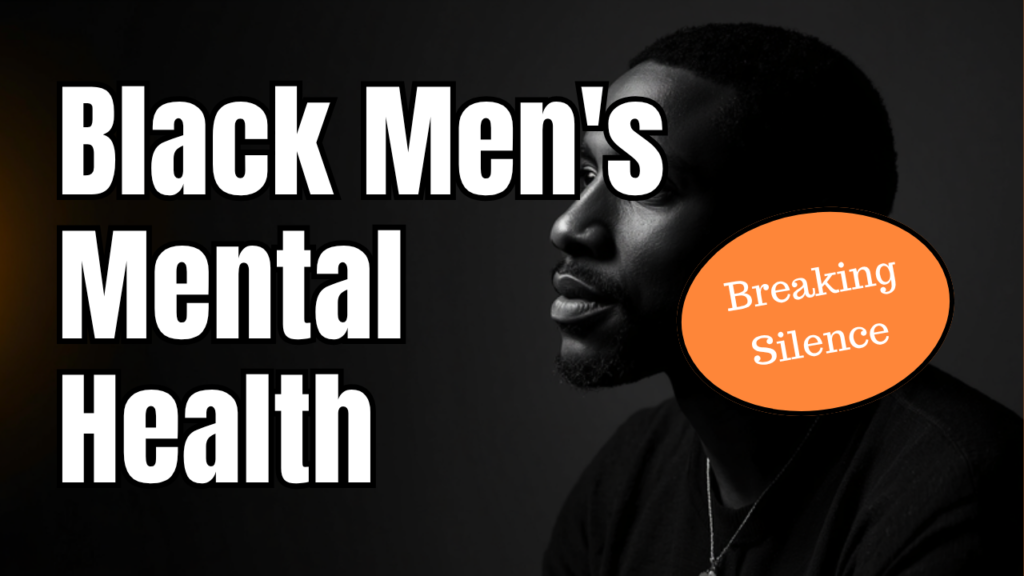
I don’t write about mental health as a journalist looking in from the outside. I write about it as a combat veteran who came home and had to learn, the hard way, that “I’m good” is not a diagnosis — it’s a habit. So when I see the current data on Black men’s mental health, I don’t read it as an abstract public health story. I read it as a warning about guys I know.
The research is consistent and it is not encouraging. Deaths from suicide, overdoses, and alcohol abuse are rising among Black Americans, and recent trends show a specifically alarming surge among young Black men. The National Institute of Mental Health has documented that Black men die by suicide at rates significantly higher than Black women — a gap that gets less attention than it should, because the conversation about Black mental health has, for good reason, spent years centered on Black women and girls. Men have been an afterthought in a crisis that is quietly killing them faster.
Here’s the part that should make every one of us pay attention: only about 5% of psychologists in this country are Black, roughly 2% of psychiatrists, and about 11% of licensed professional counselors. If you’re a Black man who finally decides to walk into therapy — a decision that already fights against decades of cultural messaging that treats vulnerability as weakness — the odds are overwhelming that the person across from you will not share your lived experience, and may not have been trained to recognize how racism, hypervigilance, and generational trauma show up in a Black man’s body and behavior differently than in a textbook case study.
There’s real progress worth naming, and I won’t pretend there isn’t. More public figures — athletes, veterans, entertainers — are talking openly about therapy in 2026 than at any point I can remember. Long-form podcast conversations have done more to normalize a Black man saying “I’m not okay” than a decade of public service announcements did. The definition of masculinity is shifting, slowly, toward one that has room for a man who cries, who asks for help, who admits the war — literal or otherwise — didn’t end when he got home. I’ve built a chunk of my own platform on exactly that message, because I lived the alternative and it nearly cost me everything.
But visibility isn’t access. A viral clip of a rapper talking about his therapist doesn’t create one more Black therapist in Milwaukee. It doesn’t shorten the six-week wait to get seen at the VA behavioral health clinic. It doesn’t pay the co-pay. Culture can open the door; it cannot fill the workforce gap or fund the sliding-scale clinic. Those are policy problems and funding problems, and they need to be treated as urgently as the cultural stigma problem — because right now we’re winning the conversation and losing the war on outcomes.
What actually moves the needle, from where I sit: expanding loan forgiveness and scholarship pipelines that get more Black men into psychology and psychiatry programs in the first place, not just diversity statements from grad schools that don’t change who gets funded. Faith communities training clergy — who are often the first and only person a Black man in crisis will talk to — in basic mental health first aid, so pastors can recognize a crisis and make a warm handoff instead of just praying over it and hoping. Veterans’ organizations partnering directly with community mental health providers instead of routing everyone through an overwhelmed VA system alone. And men themselves — myself included, still — normalizing the follow-up. Going back for session two. Telling your boys where you go on Tuesday afternoons instead of hiding it like something shameful.
The crisis isn’t a mystery. The solutions aren’t either. What’s missing is the will to fund them at the scale of the problem instead of the scale of a hashtag.