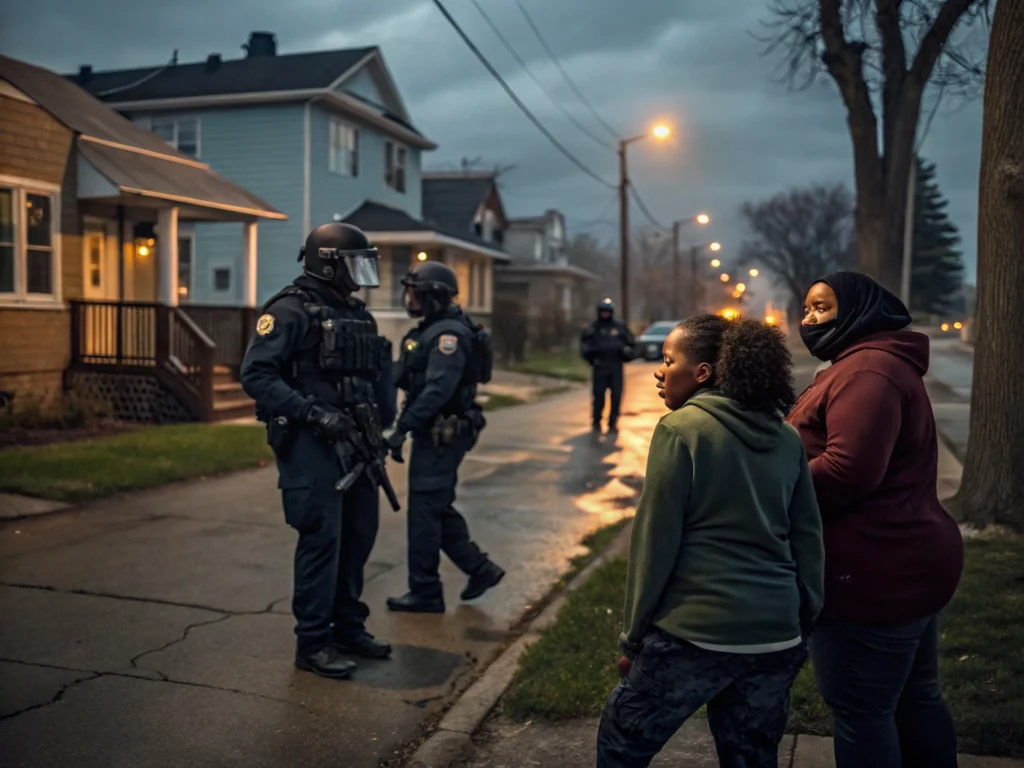
Between June 29 and July 1, federal immigration agents arrested 57 people across Wisconsin in one of the largest enforcement sweeps the state has seen since the current administration returned to office. A few days later, ICE conducted another surge that Urban Milwaukee reported brought the three-day total closer to 60 arrests. Witnesses described masked agents following people through neighborhoods, breaking car windows, and making arrests in front of children. At least once, agents reportedly used a Milwaukee Police Department parking lot as a staging area.
Then came the letter. On July 10, the Department of Justice notified Mayor Cavalier Johnson and City Attorney Evan Goyke that federal agents will not comply with Milwaukee’s mask ban — the ordinance the city passed specifically to require identifying uniforms or visible badges during enforcement actions — and demanded assurance the city won’t try to enforce it against ICE by July 17.
I want to be precise about what this is and isn’t, because precision is exactly what gets lost when a story moves this fast. This is not a story about whether immigration law should be enforced. Federal immigration enforcement is a real function of a real federal agency, and reasonable people disagree — sometimes sharply — about how aggressive that enforcement should be. What this is a story about is process, accountability, and the basic expectation that people enforcing the law in your neighborhood can be identified while they’re doing it. Milwaukee didn’t pass a law abolishing ICE. It passed a law saying: if you’re detaining someone on our streets, show your face and your badge. The DOJ’s response was, in effect, no.
That distinction matters because it’s exactly the kind of nuance that gets flattened by both sides of the national conversation. One side wants this story to be entirely about border security and criminal removals. The reporting doesn’t support that framing — U.S. Rep. Gwen Moore has said publicly that the operations have been targeting people without criminal records, not the “worst of the worst” language used to justify the surge. The other side wants this story to be entirely about federal tyranny, full stop, no complexity. That framing skips past the actual, specific, answerable question at the center of this: should federal agents operating inside American neighborhoods be identifiable to the people they’re detaining and the communities watching it happen? That’s not a partisan question. It’s a due-process question, and Milwaukee residents deserve a straight answer to it instead of a proxy fight.
For families in the neighborhoods where this enforcement is happening, the politics are secondary to the practical reality of masked, unidentified agents showing up during the day. So let’s talk about what’s actually useful right now.
First, know your rights doesn’t mean nothing when it’s cited correctly. You do not have to open your door for ICE agents unless they have a signed judicial warrant — not an administrative ICE warrant, which is a form the agency fills out itself, but one signed by a judge. That distinction is the single most important piece of information a family in Milwaukee can carry right now, and legal aid groups across the city, including Voces de la Frontera and the ACLU of Wisconsin, have been distributing red cards and rapid-response hotline numbers specifically because most people don’t know it.
Second, document without escalating. Wisconsin is a one-party consent state, meaning you can legally record public interactions on your own property or in public space. Rapid response networks in Milwaukee have been organizing exactly this kind of documentation, both to protect due process and to create a public record independent of official accounts, which have been contested in nearly every recent incident.
Third, this is a moment for elected officials — city, county, and Wisconsin’s congressional delegation — to be pressed publicly and specifically, not just quoted reacting to news. Mayor Johnson and City Attorney Goyke have a July 17 deadline hanging over them. Milwaukee residents, whatever their politics on immigration broadly, have a legitimate interest in knowing whether the city intends to defend its own ordinance or fold to the DOJ letter, and that’s a question worth asking directly rather than assuming an answer.
I’ve been on the other side of a uniform. I understand the instinct to give law enforcement operational latitude and the benefit of the doubt. I also understand, from very personal experience, why identification and accountability aren’t optional extras bolted onto that latitude — they’re what separates legitimate authority from something else. Milwaukee families didn’t ask to be at the center of that argument this month. They are anyway, and the most useful thing UNJ can do is make sure they have accurate information instead of noise from either direction.