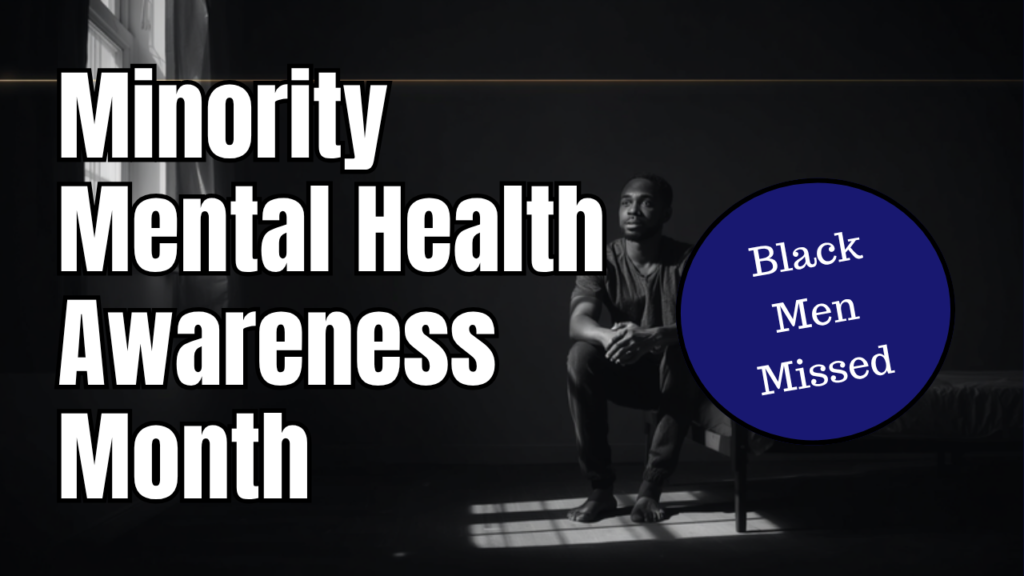
Every July, the same headlines resurface: Minority Mental Health Awareness Month is here, treatment gaps persist, Black Americans are less likely to get care than they need. Every July, the statistics move in the same direction. This year is no exception, and if you’re a Black man reading this, the numbers probably won’t surprise you nearly as much as they should alarm the people setting health policy.
The data for 2026 is not ambiguous. Deaths from suicide, overdose, and alcohol-related causes are rising among Black Americans, and researchers point to a specific and unprecedented surge among young Black males. The National Institute of Mental Health has tracked for years that Black men die by suicide at meaningfully higher rates than Black women — but the trend line among young men has become steep enough that clinicians are calling it a crisis rather than a disparity. Layer onto that a familiar structural fact: Black adults are roughly a third less likely to receive mental health treatment in a given year than white adults, despite reporting similar or higher rates of anxiety and depression. That gap isn’t new. What’s changed is how much worse the outcomes have gotten while the gap stayed the same size.
I want to be careful here, because this is the point where a lot of mental health journalism goes soft and vague — “we need to talk about it,” “stigma is the enemy,” roll credits. That framing isn’t wrong, but it’s incomplete to the point of being a little dishonest. Stigma is real. It is not, on its own, why a working man in his 30s in Milwaukee doesn’t walk into a counselor’s office. Access is real too — there is a documented shortage of Black mental health providers, and matching matters; research consistently shows patients are more likely to stay in treatment when they see a provider who understands their context without having to explain it first. But underneath stigma and access sits something harder to fix with a hotline number: mistrust of the systems doing the treating.
That mistrust has history. It didn’t come from nowhere. Generations of Black men have watched institutions — medical, psychiatric, correctional, sometimes all three wearing the same badge — treat their pain as a management problem rather than a health problem. A man who grew up watching relatives get diagnosed, medicated, or institutionalized rather than heard does not walk into a new clinic assuming good faith. Add masculinity norms that most American men absorb regardless of race — the idea that need itself is a kind of failure — and you get a population that is simultaneously carrying more and disclosing less. That combination is what’s showing up in the mortality data.
Veterans carry a version of this that deserves its own sentence, not a footnote. Black veterans navigate all of the above plus a VA system that, for all its real improvements, still asks men trained not to show weakness to walk in and describe their worst moments to a stranger in a government building. I’ve sat in enough of those waiting rooms myself to know the posture in the room before anyone says a word. The men who make it through the door aren’t the problem. The men who never do are.
So what actually moves the needle, as opposed to what makes a good awareness-month press release?
Here’s where I’ll give credit where it’s earned. The JED Foundation — a well-regarded nonprofit focused on youth and young-adult mental health — announced this year it’s partnering directly with Alpha Phi Alpha Fraternity, Inc. through JED’s Greek-Letter Organizations program, aiming to address the mental health crisis inside a structure Black men already trust: brotherhood built on decades of relationship, not a clinical intake form. That’s a meaningfully different model than “here’s a hotline, good luck.” Fraternities, churches, veteran service organizations, barbershops — the institutions Black men already show up to for other reasons are the ones best positioned to be the first conversation, even if they’re not the last one. A brother checking on a brother isn’t therapy. It’s the on-ramp to therapy, and for a lot of men, it’s the only on-ramp that works.
Locally, this same logic applies. Milwaukee has community-based organizations and veteran service groups doing exactly this kind of relational outreach, but they’re chronically underfunded relative to the clinical infrastructure that Black men are least likely to use. If the county and state health departments are serious about closing the treatment gap — and to their credit, Wisconsin has expanded some community mental health grant funding in recent budget cycles — the money should follow where the trust already is, not where the org chart says it should be.
I’d also push back gently on one thing inside our own community: the instinct to treat every mental health conversation as purely a “system failed us” story. Systems have failed, and that’s documented above. But there’s also an individual piece that solution-first journalism has to name honestly — the culture that tells boys crying is weakness needs pushback from inside the culture, not just from outside policy. Fathers, coaches, pastors, and older brothers can normalize disclosure in a way no federal program can mandate. That’s not blaming the men who are struggling. It’s recognizing that healing this particular gap requires both institutions and individuals to move, and pretending it’s only one or the other lets everybody off the hook a little too easily.
None of this requires waiting on Washington. A local church small group that includes fifteen minutes of “how are you really doing” costs nothing. A fraternity chapter formalizing what the JED partnership is doing nationally costs a meeting agenda item. A veteran service organization pairing newly separated vets with a peer who’s five years further down the road costs a phone list. These are not radical interventions. They’re the interventions that were always going to work, because they route around the trust problem instead of trying to argue a man out of it.
Minority Mental Health Awareness Month will end on July 31st, same as it does every year, and the awareness will fade back into the general noise of August. The men behind these statistics don’t get that same reset. If UNJ readers take one thing from this piece, let it be this: check on your people specifically, not generally. “I’ve been thinking about you” lands differently than “let me know if you need anything.” One is an obligation you’re handing someone else. The other is a door you already opened.
— Marcus Hart