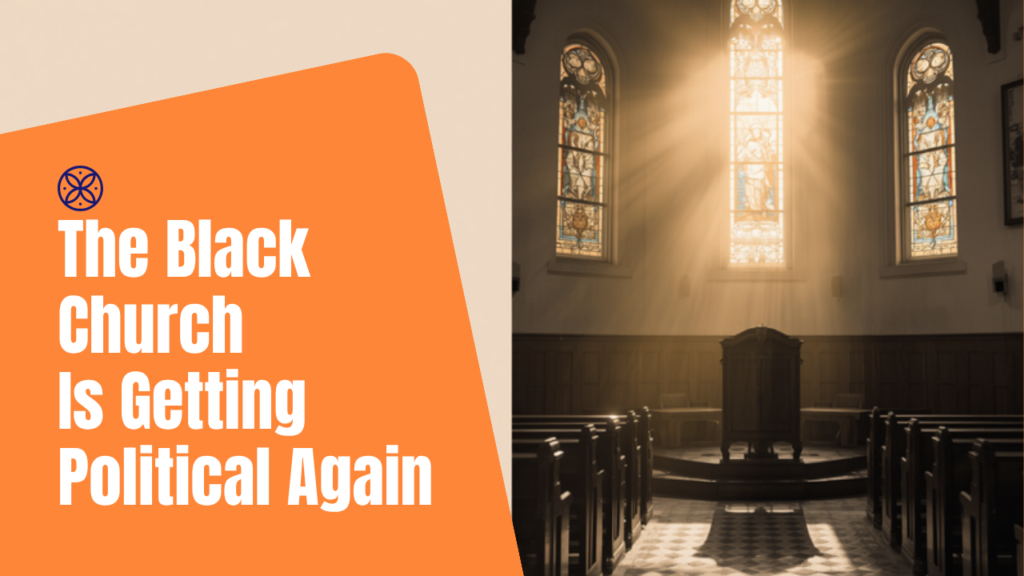
Every couple of election cycles, somebody rediscovers that Black churches are organizing voter registration drives and poll chaplain programs, and treats it like a scandal — pastors abandoning the gospel for politics, mixing what should stay separate. I understand the instinct. I also think it fundamentally misreads both the Black church’s history and what’s actually happening in sanctuaries across this country right now, including some not far from where I sit in Oak Creek.
This year, that mobilization is visible and organized. Leaders at the Progressive National Baptist Convention’s annual session sent a clear message to churches heading into the November midterms: get out the vote. In the D.C. metro area, Black faith leaders are organizing mayoral debates, voter registration drives, and poll chaplain programs specifically framed as a response to federal challenges to voting rights. Metropolitan AME Church built an intergenerational Faith Action Committee with an explicit goal — a “100% voting congregation.” And in South Carolina, where Pew Research estimates roughly 700,000 adults identify with historically Black Protestant traditions, church leaders are treating that number as exactly what it is: a constituency large enough to reshape a statewide election.
Here’s what the “keep politics out of the pulpit” critique gets wrong: the Black church was never a purely spiritual institution insulated from the world outside its doors, and it never claimed to be. It was the organizing hub of the Underground Railroad. It trained and launched the leadership of the Civil Rights Movement out of literal church basements. Dr. King preached from a pulpit and organized a movement from the same platform because, in the Black American experience, “get free” and “get right with God” were never two separate projects — they were one project, understood as one calling. A Black church that stayed silent on justice in 1963 would have been the aberration, not the norm. What we’re watching now isn’t a new politicization. It’s a return to form after a stretch where some congregations, for understandable reasons — tax-exempt status concerns, donor sensitivities, exhaustion — pulled back from that role.
That said, I’m not going to pretend there’s no tension worth naming honestly, because pretending otherwise would be its own kind of dishonesty. There’s a real difference between a church equipping its members to exercise their full rights as citizens — registration drives, know-your-rights sessions, rides to the polls, poll chaplains present to de-escalate intimidation — and a church functioning as a partisan campaign arm for one party’s candidates. The first is civic discipleship. The second risks the church’s independence and its prophetic voice, the thing that lets a pastor hold any politician of any party accountable to a higher standard instead of becoming that politician’s validator. The 501(c)(3) restrictions on endorsing specific candidates exist for a reason, and the churches doing this work well — the ones organizing turnout without turning the sanctuary into a campaign office — understand that line and hold it.
What I’d ask congregations leaning into this work to hold onto: mobilization without partisan capture. Register everybody. Turn out everybody. Ask hard questions of every candidate who wants your congregation’s support, from every party, and don’t let any of them treat your church as a guaranteed vote they don’t have to earn. That posture — civically engaged, spiritually independent, accountable to God before it’s accountable to any party — is the actual tradition worth reviving. Not silence dressed up as neutrality. Not partisanship dressed up as prophecy. The narrow path in between, which has always been harder to walk than either extreme, and always mattered more.