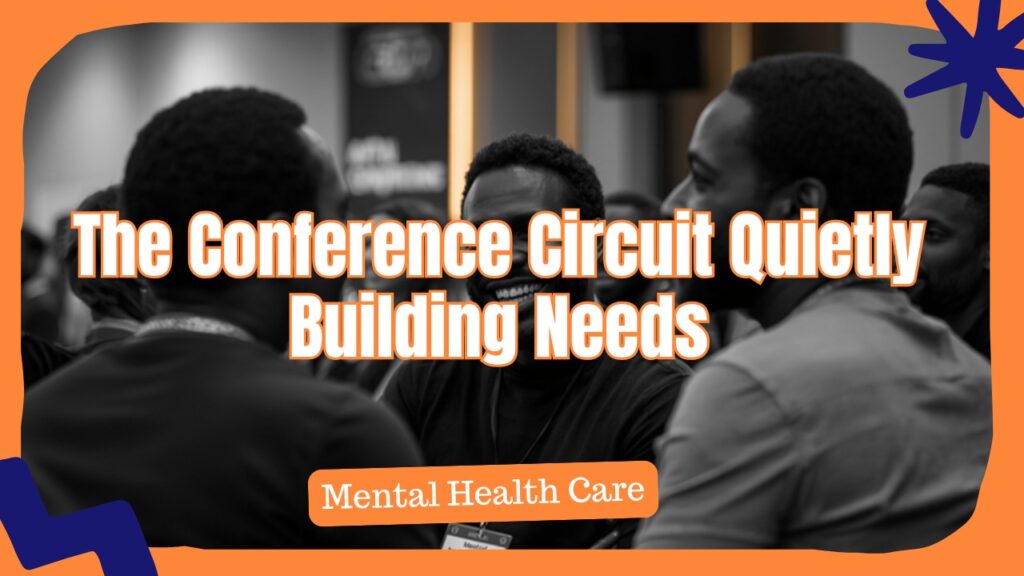
Every July, the culture runs its familiar cycle: a hashtag, a handful of op-eds, a wave of “Black men need to talk about their mental health” commentary, and then, by August, silence again until next year’s awareness push. I’ve written versions of that critique myself. But something different has been building this year that deserves its own coverage, separate from the usual awareness-month cycle — a genuine circuit of in-person conferences that are less about raising awareness and more about building actual infrastructure.
On July 11, First Neighborhood Place hosted a Black Men’s Mental Health Conference at Western Middle School for the Arts in Louisville. It wasn’t a symbolic gathering. The agenda included panel discussions and interactive workshops covering addiction recovery, reentry support after incarceration, career pathways and vocational training, direct mental health services, and expungement assistance — the kind of wraparound programming that treats mental health as inseparable from housing, employment, and legal status rather than as an isolated clinical issue. Two weeks later, a similar conference convened in Atlanta on July 25, part of what’s shaping into a genuine multi-city circuit rather than a one-off event.
The data underneath these conferences is grim enough to explain the urgency. Black men die by suicide at significantly higher rates than Black women, and recent trends point to an alarming surge specifically among young Black males. Commentary from outlets across the Black press this year has converged on the same diagnosis: cultural expectations around masculinity, a deep and often justified mistrust of mental health systems, and a persistent shortage of Black providers are keeping men out of care even when they know something is wrong. None of that is new information to anyone who’s spent time in this community. What’s newer is the shift I’m actually seeing on the ground — more Black men choosing therapy, choosing honest conversation, choosing to name what they’re feeling instead of burying it, according to reporting out of outlets covering this shift directly this year.
I’ll add my own lens here, because I think it’s relevant. I came home from combat and spent longer than I’d like to admit treating silence as strength. That’s the same script a lot of Black men are handed long before they ever put on a uniform — be the provider, be unshaken, handle it alone. What broke that pattern for me wasn’t a hashtag. It was sitting in an actual room with people who’d been where I’d been, and later, it was a faith community that gave me language for what I was carrying without ever making me feel like I needed to perform having it together. That’s precisely the model these conferences are trying to scale: not just awareness that a problem exists, but a physical room, a specific Saturday, a panel of people who’ve done the work, and a clear next step for someone who walks in not knowing where to start.
The honest critique of the conference model is that it still reaches a limited number of people relative to the scale of the crisis, and that one Saturday in Louisville or Atlanta doesn’t fix a shortage of Black therapists or a health system that too often mishandles Black men’s pain, physical or psychological. Those structural gaps are real and conferences alone won’t close them. But there’s a difference between a symbolic gesture and a functioning on-ramp, and what I’m seeing in these events — expungement help sitting next to therapy referrals sitting next to job training — looks more like the latter. If this circuit keeps expanding city by city, it’s worth watching not as a feel-good story but as a genuine test of whether community-built infrastructure can do what awareness months consistently fail to: get a man from “I know something’s wrong” to an actual appointment, an actual mentor, an actual next Tuesday.