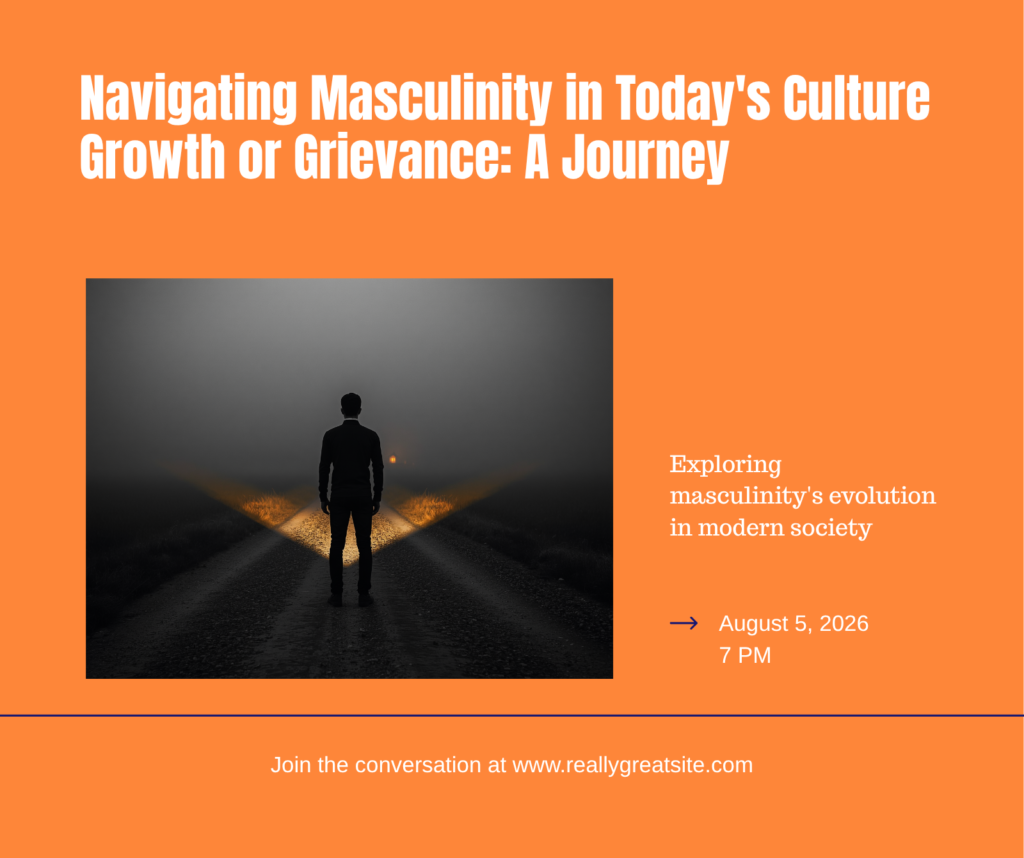
I came home from war to a country that didn’t have a clean script for what I was supposed to do with what I’d carried back. Nobody does, honestly — that’s not a complaint, it’s just the starting condition for a lot of men my age and younger. What’s changed since then isn’t the confusion. It’s what’s rushing in to fill it.
Cultural researchers and writers tracking American masculinity in 2026 keep landing on the same split, and I’ve seen it up close enough in my own community to know it’s real: men under the same pressures — economic uncertainty, social disconnection, a provider role that doesn’t map cleanly onto today’s economy, a documented crisis in male role models — are sorting into two different responses. One path is what you’d call growth: therapy, mentorship, honest reckoning with what isn’t working, a willingness to be a student again in your thirties or forties. The other path researchers are now naming plainly as “grievance masculinity” — status anxiety and resentment organized into a worldview where every personal setback gets explained by someone else’s gain, usually framed as a gender war.
I want to be careful here, because I know how this kind of piece usually gets used — as a stick to beat men over the head with for having any complaints at all. That’s not what I’m doing. The grievances aren’t fake. Wages haven’t kept pace with what a stable life used to cost. Work has stopped being what researchers now call a “life container” — a stable structure you build an identity around — and become more like a moving platform you’re just trying to stay on. Young men really are reporting record levels of loneliness and disconnection. None of that is manufactured.
What I’m saying is that real pain and a real diagnosis of its cause are two different things, and grievance masculinity, as a marketplace, sells you the first while lying to you about the second. It tells a man his isolation is somebody’s fault by design rather than a byproduct of an economy and a culture that under-invested in male friendship, mentorship, and emotional literacy for two generations running. That’s a much more comfortable story than “you have to do the work of rebuilding connection yourself, and it will be slow.” Comfortable stories sell. That’s not new — I’ve watched plenty of preachers, plenty of politicians, and plenty of hustlers sell the comfortable version of the truth instead of the accurate one.
Here’s where faith, for me, isn’t a wall against this conversation but a lens on it, and I’ll say it plainly rather than dance around it: every serious spiritual tradition I know of treats grievance-nursing as a trap, not a virtue. Not because the injuries aren’t real, but because a life organized around who wronged you is a life that never gets to build anything. Growth-path masculinity and most faith traditions are pointed the same direction — toward accountability, toward service to something outside yourself, toward the idea that your pain is real and your response to it is still your responsibility.
I think about the guys I served with who came home and either found a church, a gym crew, a trade, a mentor, a therapist — something that pulled them back into structure and relationship — versus the guys who found a feed that told them their anger was righteous and their isolation was someone else’s fault. I watched both roads up close. One group is, by and large, building lives. The other is still online at 2 a.m., angrier than they were a year ago, no closer to anything.
If you’re a man reading this and you recognize yourself more in the second group than the first, I’m not writing this to shame you — I’m writing it because I believe you can still choose the other road, and because every man I know who’s crossed over says the same thing: it’s harder at first and better after. Find one relationship, one mentor, one room full of men further down the road than you, and start there. The algorithm will still be there selling grievance tomorrow. It’ll wait.
Sources: The Good Men Project (“6 Ways We See Masculinity Changing in 2026”), commentary via Medium and Itemlive on 2026 masculinity trends