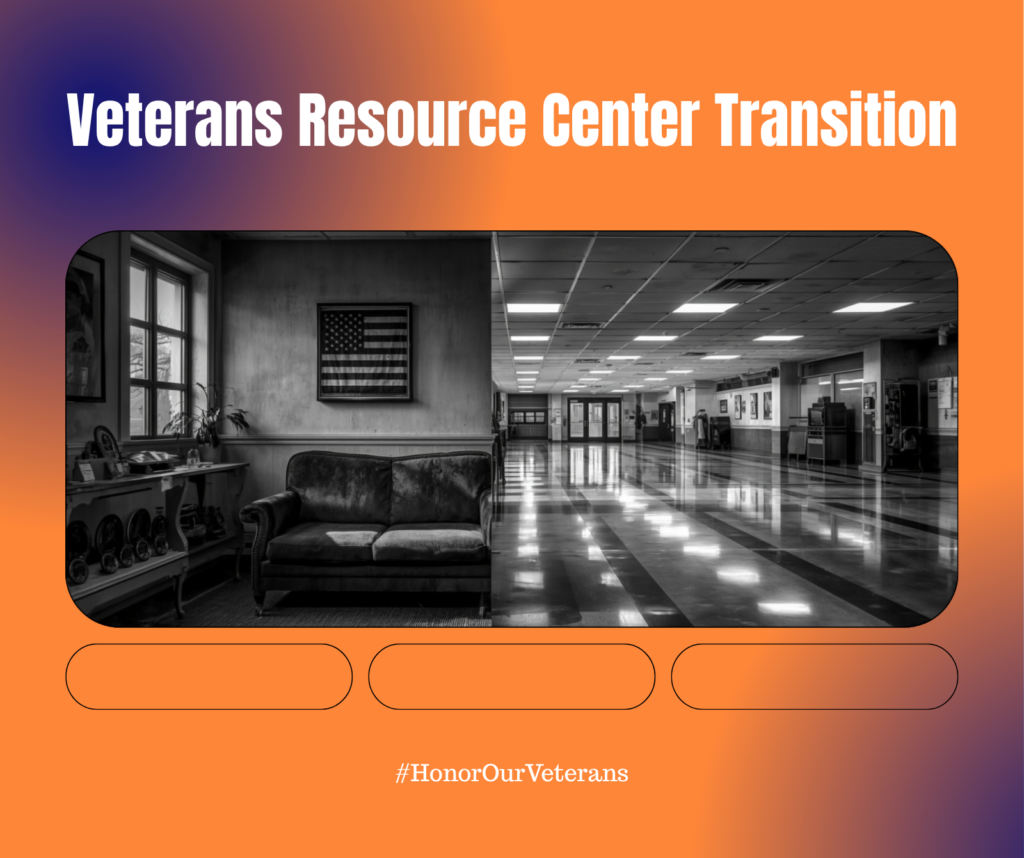
Every veteran I know who’s used a campus resource center will tell you the same thing about why it worked: it wasn’t the paperwork help, though that mattered. It was that you could walk into a room and not have to explain yourself first. Nobody there needed you to translate what deployment meant, or why a fire alarm in a crowded lecture hall might hit different for you than for the 19-year-old next to you. That kind of room is small, unglamorous, and — according to the people who actually run university budgets — apparently expendable.
The University of Wisconsin-Milwaukee is consolidating eight separate identity- and population-based student centers — the Black Student Cultural Center, the LGBTQ+ Resource Center, the Roberto Hernández Center, the Southeast Asian American Student Center, the Women’s Resource Center, the First-Generation+ Resource Center, the Off-Campus Resource Center, and the Military & Veterans Resource Center — into a single shared hub on the ground floor of the Student Union. Planning sessions ran through spring and summer 2026, with students and staff invited to weigh in on the design and eventual name. UWM’s framing is coordination and efficiency: fewer scattered offices, more collaboration, one accessible front door for support services. Reporting from Urban Milwaukee and TMJ4 shows veteran students pushing back, worried that folding a specialized, trust-built space into a larger shared center will dilute exactly the thing that made it work.
I understand both sides of this, and I want to say that plainly before I tell you where I land. University budgets are real. Duplicated administrative overhead across eight small centers is a legitimate thing to want to fix, and nobody serious argues that identity-based support offices should be immune from ever being examined for efficiency. That’s a fair conversation to have.
But efficiency and specialization aren’t actually in tension here nearly as much as the plan suggests, and this is where I think UWM’s messaging is doing more work than the substance can support. A shared front desk, shared administrative staff, shared event space — sure, consolidate that. What veterans are describing losing isn’t square footage. It’s the specific, quiet credibility of a room that exists only for people who’ve worn the uniform, staffed by people who get why a student who did two combat deployments might not want to process a benefits question in the same open lounge as a general campus event. That kind of trust doesn’t transfer when you move the furniture. It gets rebuilt from scratch, slowly, if it gets rebuilt at all — and in the meantime, the students who most need to walk through that door are the ones most likely to just stop showing up.
This matters beyond UWM’s campus, and it matters to Milwaukee specifically. Wisconsin already has one of the more fragile veteran-support ecosystems in the Midwest relative to demand — you can see it in the fights over funding for the Center for Veterans Issues, in the years-long campaign to get the Milwaukee Homeless Veterans Initiative properly resourced, in every story about a veteran falling through a gap between the VA, the county, and the nonprofit sector. A university that successfully supports its student veterans through to graduation is one of the more effective, least expensive interventions in that whole ecosystem — a veteran with a UWM degree in hand is a veteran who is far less likely to end up needing the more expensive, more urgent interventions those other organizations exist to provide. Shortchange that pipeline quietly, in the name of an efficient floor plan, and you don’t save money. You just move the cost downstream to agencies with fewer resources than a university has.
If UWM wants to prove the skeptics wrong, there’s a straightforward way to do it: commit publicly, in writing, to dedicated veteran-only staff hours, a private meeting space within the shared hub reserved specifically for benefits and mental health conversations, and a veteran student on the design committee with real input rather than a listening seat. That’s not expensive. It’s a choice about whether “consolidation” is actually about saving the specialized trust those centers built, or just about saving square footage and calling it the same thing.
Sources: Urban Milwaukee (“Merger of Student Centers at UWM Raises Concerns,” Feb. 2026), TMJ4 (“UWM veterans worry new shared center will weaken their specialized support”), UWM Military & Veterans Resource Center (uwm.edu/mavrc)