By Marcus Hart | The Urban News Journal
The 2026 World Cup has quietly become the most politically layered sporting tournament in a generation. Two days ago, this column examined how Belgium’s 4-1 demolition of the United States and the simultaneous NATO summit in Ankara produced a collision of geopolitics and football that no screenwriter could have engineered. Tonight in Boston, the quarterfinals serve up something with even deeper historical roots.
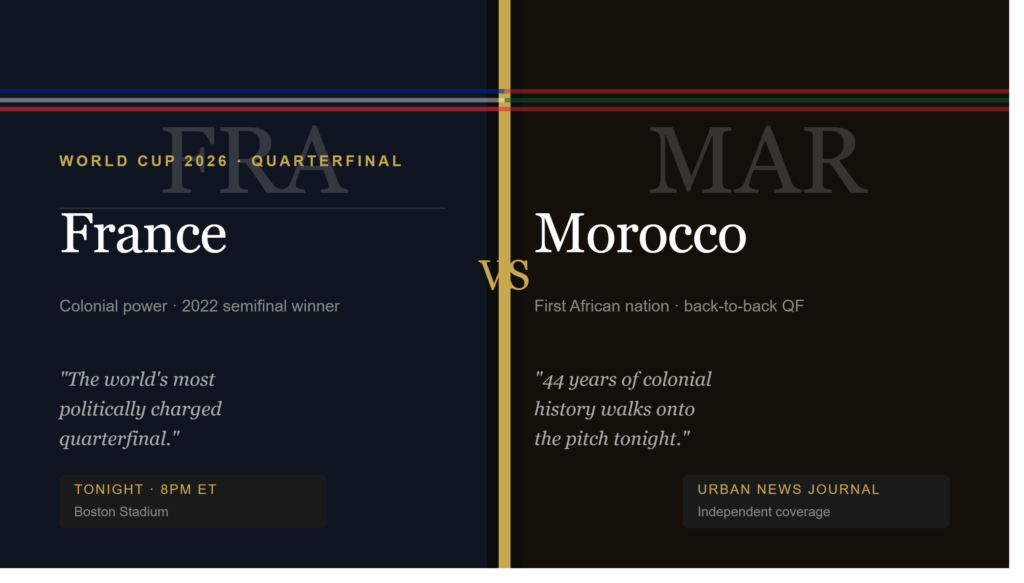
France takes on Morocco at Boston Stadium on July 9th, with a place in the semi-finals on the line — the seventh meeting between these football nations, and the second on this specific stage. But the history between France and Morocco on a football pitch cannot be separated from the history between France and Morocco off of it. And that history is not ancient. It is alive, contested, and present in the stands of every stadium where these two nations meet. Campaign Legal Center
What the Scoreline Will Never Capture
Morocco is not simply a football team. It is the first African nation to advance to the final eight in back-to-back World Cups — a fact that carries weight far beyond the bracket. In 2022, Morocco’s run to the semi-finals in Qatar was received across the African continent and the Arab world as a vindication of decades of marginalization in global football. The sight of Moroccan players celebrating in front of a sea of Palestinian flags after their wins sent a message that the sport’s governing bodies could not suppress and the European football press struggled to contextualize. 365Scores
Tonight they face the country that colonized them for forty-four years.
France controlled Morocco from 1912 to 1956 under a protectorate that extracted resources, suppressed cultural identity, and left institutional scars that continue to shape Moroccan society. The Moroccan diaspora in France — numbering in the millions — represents one of the largest immigrant communities in Europe and one of the most politically contested. French domestic debates about immigration, identity, and Islam have for decades used the Moroccan and broader North African community as their central reference point. Marine Le Pen built a political movement on it. Emmanuel Macron has navigated around it carefully for years.
When France plays Morocco on a football pitch, all of that walks onto the field with the players.
The 2022 Template and What Changed
The most recent and arguably most significant encounter between these sides came four years ago when they were pitted against one another in the semi-finals of the 2022 FIFA World Cup. France won that match 2-0. But the result was almost secondary to what the tournament had already demonstrated — that Morocco belonged on the same stage as any European nation and that African football had arrived at a new threshold. Campaign Legal Center
What has changed since 2022 is the political climate in which this rematch is taking place. France is currently governed by a coalition navigating significant internal pressure on immigration and national identity. Morocco has deepened its diplomatic and economic ties across Africa and the Gulf while managing a complex relationship with its former colonial ruler that oscillates between partnership and friction. The Moroccan national team itself is a living symbol of that complexity — Brahim Díaz, who has more goal contributions than any Morocco player since January’s Africa Cup of Nations, was born in Málaga, Spain. Achraf Hakimi was born in Madrid. Multiple members of this squad hold dual citizenship between Morocco and European nations. They are a team built from the diaspora — children of the migration that colonialism created, now representing the country of their heritage on the world’s biggest stage. 365Scores
France’s squad carries its own version of this story. Kylian Mbappé, the most electric player of his generation, is the son of a Cameroonian father and an Algerian mother. He is the face of a French football identity that is multiracial, post-colonial, and perpetually in tension with the monocultural nationalism that a significant portion of the French electorate supports. France have been the standout team of the tournament so far, breezing through the group stages and entering tonight’s match as clear favorites. But favorites carry the weight of expectation, and in a match this charged, expectation is its own pressure. Supreme Court of the United States
Boston as the Stage
There is something pointed about this match being played in Boston. The city that gave the United States the Boston Massacre and the Tea Party — foundational events in a story America tells about itself as a nation that rejected colonial authority — is hosting a match between a former colonial power and the country it colonized. The irony is either lost on FIFA or entirely intentional. Given FIFA’s track record, the former is more likely.
What is certain is that Boston’s Moroccan and North African community will make itself heard tonight. The 2022 World Cup demonstrated that Moroccan supporters could fill stadiums across continents — traveling in numbers that no European commentator had anticipated and creating an atmosphere that tilted arenas toward a narrative the established football world was not prepared for. Tonight in Boston, that energy will be present again.
What to Watch For Beyond the Score
On the pitch, this is a genuinely compelling tactical contest. Mbappé has been on a heater and is only one goal shy of Lionel Messi in the Golden Boot race heading into tonight’s match. Morocco enters with a significant injury concern — Ismael Saibari exited the Round of 16 match against Canada after 22 minutes with a hamstring issue and his availability remains uncertain. He has been one of Morocco’s most impactful players, scoring in multiple matches across the tournament. 365Scores365Scores
France are looking to reach their third straight semi-final and become only the third team to advance to the final four three consecutive tournaments in a row. That kind of consistency represents the establishment of world football — the power that Morocco is once again positioned to disrupt. Supreme Court of the United States
But the real question tonight is not tactical. It is cultural. When a Moroccan player scores at Boston Stadium, who erupts in the stands? When a French player lifts his hands to the crowd, who answers? The scoreline will tell you who advances. The crowd will tell you something about the world we actually live in.
The UNJ Lens: What Independent Journalism Has to Say
The mainstream sports press will cover this match as a football event with a historical footnote. The progressive press will frame it primarily as a referendum on French colonialism. The conservative press, where it covers football at all, will miss the cultural dimension entirely.
The independent view is more complicated and more honest than any of those frames. France and Morocco are both sovereign nations with legitimate football programs and legitimately great players who have earned their place in this quarterfinal. The colonial history between them is real and relevant and should be named — but it does not predetermine the outcome or dictate who anyone should want to win. Sports is one of the few arenas where those histories get contested on equal footing, by the actual children of both nations, under the same rules, on the same pitch. That is not nothing. In fact, in 2026, it might be one of the most honest arenas we have left.
Tonight at 8 PM ET. Boston Stadium. France vs. Morocco.
Watch it for the football. Understand it for everything else.
Marcus Hart is the founder of the Transform U Media Network and editor of The Urban News Journal. Follow independent coverage of politics, sports, and culture at urbannewsjournal.com.