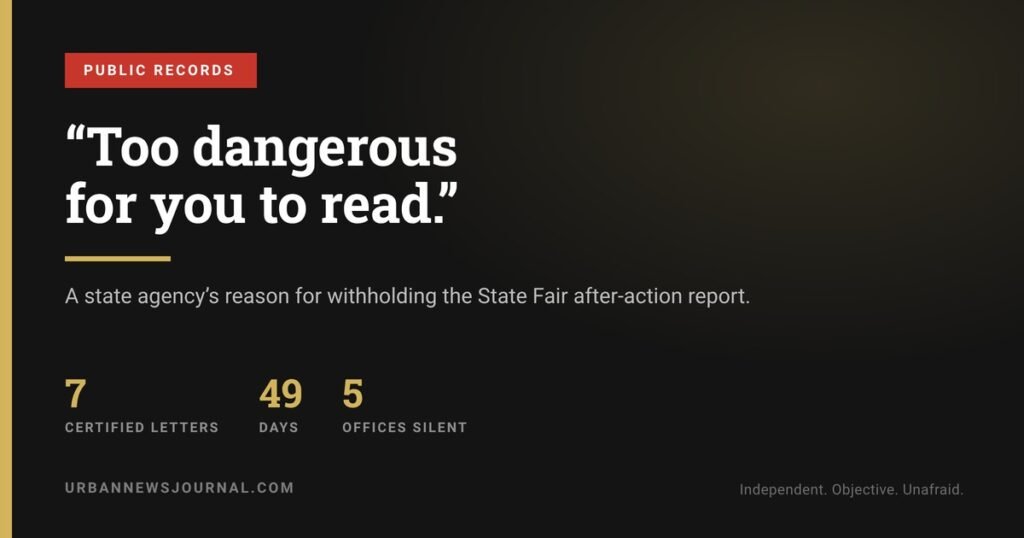
A state agency told us that answering our question would endanger the public.
Not that the record doesn’t exist. Not that we filed it wrong. That you are safer not knowing.
On September 28, Urban News Journal mailed seven certified letters at a cost of $77.14, paid out of pocket. One question: what happened on the last night of the Wisconsin State Fair, and what are you changing.
Forty-nine days later, five of those seven offices have never sent back a single word. Not a denial. Not a delay letter. Nothing.
The board, as it stands
Two offices have answered, and both said the same thing in different words.
- West Allis Police Department, October 7. No records. They assisted State Fair Park Police and made no arrests.
- The West Allis mayor and alderpersons, October 16. No records, and no control over State Fair Park security or reporting.
Wisconsin State Fair Park has produced exactly one document in forty-nine days: a handwritten booking log from August. That is not the after-action report, and we have never called it one.
The Governor’s office, the Milwaukee County Executive’s office, and the Attorney General’s Office of Open Government have never responded at all. That last one exists in this state for one purpose: making sure public records get handed over.
What we actually asked for
State Fair Park’s position is that releasing the after-action report, or the 2027 safety plan, would endanger the public by exposing security plans.
That argument deserves to be measured against the request it is answering. The letter did not ask for one document. It asked for six things:
- The after-action report, including the security staffing plan, officer counts by agency, and post assignments.
- The response timeline: when the disturbance began, when it was reported, when law enforcement arrived, in minutes.
- The medical status of the officer who was struck, to the extent releasable, and confirmation of any other undisclosed injuries.
- The specific charges filed against each of the seven people arrested, and which agency made each arrest.
- Whether this year’s staffing and access-control plan differed from prior years, and if so how and why.
- A public commitment, with a timeline, to any changes for the 2027 Fair.
A security-plan exemption is at least arguable on items one and five. It is harder to see how it reaches the rest. A response time is a number, and it already happened. An injured officer’s condition is a man’s health. Criminal charges are filed in open court and are public the day they are filed. A commitment to do better next year is a promise, not a vulnerability.
One word that applies to part of a request has been laid across all of it.
The door we left closed
The seven recipients were chosen on authority, not attendance. West Allis, because the Fair sits there: its mayor, its police department, the alderpersons whose district covers the grounds. Milwaukee County, because the County Executive’s residents make up most of who walks through those gates. And the state, because State Fair Park runs the grounds, the Governor’s office sits above it, and the Attorney General’s Office of Open Government is meant to make all of them comply.
That was deliberate. Everyone who answers for that ground, not everyone who showed up.
But the letter itself names three responding agencies: State Fair Park Police, West Allis Police, and the Milwaukee Police Department. If MPD officers were on that ground, MPD officers wrote something down. Incident reports. Radio traffic. A log of who was sent and when.
That is not a question about who is responsible. We have never argued MPD was responsible. It is a question about who has paper, and paper is the thing five offices have spent forty-nine days not producing.
So MPD gets a letter this week. Not a demand for an after-action report, which is not theirs to write. A records request: how many officers did you send, what time did they arrive, and what did they file afterward.
West Allis said in writing that it only assisted and made no arrests. Fine. Somebody was there. Somebody made seven arrests. Somebody wrote it down.
Same disease, different office
On Friday, November 6, the Common Council adopted Milwaukee’s 2027 city budget. Roughly $2.2 billion. Sixty-three amendments. The tax rate falls 31 cents to $7.30 and the levy rises two percent.
Mayor Cavalier Johnson has until the close of business today, Tuesday, November 17, to sign it or issue vetoes. Almost nobody has covered that as a deadline.
Riding inside the document is $1.35 million to study whether the city should take over We Energies. That amendment passed 15-0, led by Ald. Alex Brower, after an earlier version died 2-2 in committee. The borrowing repays over five or six years, and the city must hire outside expertise by February 1, 2027.
It funds a study. It does not buy a utility, condemn anything, or take over a single power line. It pays someone to tell Milwaukee whether this is even possible.
We Energies called it “the wrong path for Milwaukee,” pointing to Ann Arbor spending roughly $500,000 on a study voters then rejected, and arguing a city-run utility would cost north of $100 million a year to operate.
Here is the context that statement leaves out. Days before the vote, the Public Service Commission approved another We Energies increase: 3.9 percent in 2027 and 3.5 percent in 2028. That is six in a row.
The company’s argument against finding out what the alternative costs is that finding out would be too expensive.
To be fair, regulators did push back. They cut the allowed return on equity from 9.9 to 9.5 percent, which the Citizens Utility Board’s Tom Content puts at roughly $60 million back to ratepayers, and ordered that power plant costs for new data center customers be charged to those customers rather than to households.
Pushback, a little. The bill still goes up.
A question for readers, and we want a real answer: should Milwaukee spend $1.35 million to find out what running its own power company would actually cost? Yes or no, and one line on why. We are reading responses on Wednesday’s show.
$219 million, and a January deadline
Jody Rhodes runs Neu-Life Community Development in Milwaukee. One of its programs, Safe Place at Gwen T. Jackson School, lets a child having a bad day walk down the hall and talk to a Milwaukee County social worker, in the building, before it becomes a crisis, a suspension, or a police call.
That program has no dedicated state funding. Rhodes keeps it alive on child care subsidy dollars and grants she chases every year, and described that to Milwaukee Neighborhood News Service as “a constant hustle.”
A constant hustle, to keep a social worker in a building where the children already are.
Now the money. Wisconsin will receive at least $219 million over ten years from the Meta settlement, roughly $22 million a year, and at least half must go toward youth mental health and social media harms.
Because of a state Supreme Court ruling in July, one person decides where it lands: Attorney General Josh Kaul, who just won a third term. His office says it is actively evaluating the allocation, and Kaul has called after-school programs “certainly important.”
Anything not allocated by January falls to the Attorney General’s discretion. No published criteria. No hearing on any public calendar we can find. One office, one deadline.
Jackie Scott organizes Wisconsin Partnership for Kids, a coalition asking for $10 million a year routed to after-school programs plus 20 percent annually into an endowment so the money does not evaporate in year eleven. Her read on why this goes unfunded: after-school gets treated as extra, as fluff.
Dave Knutson handles government affairs for the Boys & Girls Clubs of Greater Milwaukee. Forty-two sites. Federal Community Learning Center money arrived twenty days late last summer. Their funding was cut 14 percent after about fifteen years of flat funding, which means it had been shrinking the whole time. And the $1.2 million a year that ran their programs inside Milwaukee Public Schools ended in June.
73.7 to 53.6
The state’s own Office of Children’s Mental Health, in its 2025 annual report, found the share of Wisconsin high school students who feel they belong at school fell from 73.7 percent in 2013 to 53.6 percent in 2023.
Seventy-four down to fifty-four in ten years. Roughly one in five Wisconsin teenagers who used to feel part of something at school, and now does not. The same report finds less than half of girls, Hispanic students, Black students, and lesbian, gay and bisexual students say they belong there.
So name the failure. The one program in this story that puts a mental health worker in the same building as the children has no line in the state budget. Not a small line. None. It survives because a director writes grant applications instead of running her program.
And the one pot of money large enough to fix that, which a court said is for youth mental health, has no public allocation process attached to it at all.
Three offices, one morning, the same disease. Somebody is holding the measure, and they are the only one who knows what is on it.
Urban News Journal is filing a records request with the Wisconsin Department of Justice for the allocation criteria and internal memos. We will report what comes back, and what does not.
Five shot, nobody in custody
Five people were shot in Milwaukee across four nights. The victims were 19, 34, 18, 25 and 44 years old. Nobody is in custody in any of the cases, and all five remain open.
The budget sitting on the mayor’s desk is the document that decides how many detectives this city can afford and whether the lights on those corners get fixed. Five open cases with no suspects is not only a policing story. It is a capacity story, and capacity is a line item.
Anyone with information can reach Milwaukee police at 414-935-7360, or Crime Stoppers anonymously at 414-224-TIPS.
The drive is open
Mayor Cavalier Johnson and County Board Chair Marcelia Nicholson-Bovell kicked off the 2026 Holiday Drive on Monday morning. The drive has run since 2007 and benefits the Metcalfe Park People’s Pantry, led by Metcalfe Park Community Bridges.
They are collecting non-perishable food, reusable tote bags, baby wipes, deodorant and similar goods. Nine drop-off sites:
- Capitol Branch library, 3969 N. 74th Street
- Zablocki Branch library, 3501 W. Oklahoma Avenue
- East Branch library, 2320 N. Cramer Street
- Community Reintegration Center, 8885 S. 68th Street
- Metcalfe Park Community Bridges, 3624 W. North Avenue, 2nd floor
- Milwaukee County Courthouse, 901 N. 9th Street
- Milwaukee City Hall Rotunda, 200 E. Wells Street
- Marcia P. Coggs Services Center, 1220 W. Vliet Street
- Milwaukee County Zoo, 10001 W. Bluemound Road
A pantry is what a city does when the other systems did not work. Both things are true at once. Go put something in a box anyway.
If you or someone in your household needs support: NAMI Southeast Wisconsin, 262-524-8886, local and offering family support. For rent, food, heat or anything larger, dial 2-1-1 for IMPACT 211, free and local, around the clock.
Urban News Journal publishes new episodes Monday, Wednesday and Friday at 9:00am Central. Our free newsletter lands twice a week — subscribe here. Documents and tips: press@marcus-hart.com. We read every one.
Independent. Objective. Unafraid.