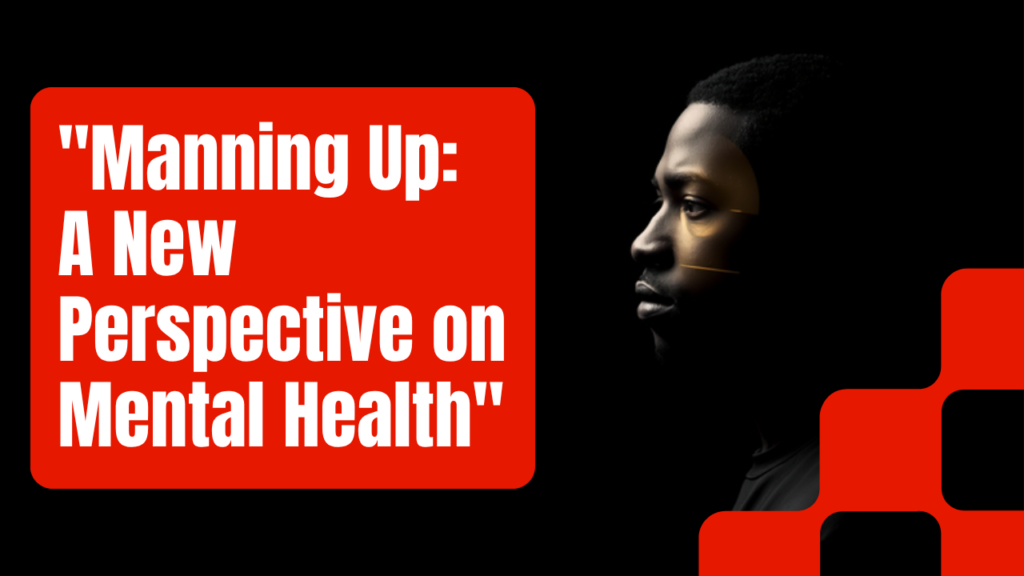
There’s a cultural shift happening right now among Black men in this country, and I’ve watched it up close both as someone who lived the old script and as someone building a platform that talks to men trying to write a new one. A recent wave of coverage — Word In Black’s reporting chief among it — has crystallized something a lot of us have felt for years but rarely said plainly: “manning up” was never actually strength. It was a survival strategy that outlived its usefulness and started costing us our lives.
The numbers behind this shift are not abstract. In 2023, only 17% of American men saw a mental health professional — roughly half the rate of women. Among Black adults specifically, treatment rates run 36% lower than their white counterparts despite similar or higher rates of anxiety and depression. And the consequence of that gap isn’t a vague wellness statistic — it’s mortality. Deaths from suicide, alcohol abuse, and overdose among Black Americans have risen sharply enough that, in the years following the pandemic, they surpassed the same death rates among white Americans for the first time on record, with those death rates roughly tripling among Black Americans between 2013 and 2022.
I don’t share numbers like that to be dramatic. I share them because I think Black culture — not just Black mental health institutions, but the culture itself, the jokes, the expectations, the version of manhood handed down at cookouts and barbershops and locker rooms — has to reckon honestly with the fact that “manning up” was training us to become statistics, not survivors.
What “manning up” actually trained us to do
Growing up, and later in the military, I learned the same script most Black men my age learned: stoicism reads as strength, self-reliance reads as maturity, and naming what you’re actually feeling reads as weakness that other men will use against you. That script isn’t unique to Black culture — plenty of research on traditional masculinity broadly finds the same pattern, that stoic, self-reliant, emotionally controlled definitions of manhood make men of every background more likely to avoid professional help, out of a real fear of being judged as weak. But for Black men specifically, that general masculine script gets layered on top of something else: a legitimate historical mistrust of mental health and medical systems that have, across generations, mismanaged, dismissed, or actively harmed Black patients, plus a genuine shortage of Black mental health providers who might actually understand the specific weight a Black man is carrying without requiring him to explain his own existence first.
Put those two things together — the general cultural penalty for showing emotion as a man, plus a specific and earned distrust of the systems meant to help — and you get exactly what the data shows: silence that isn’t really strength, just untreated pain with nowhere sanctioned to go.
Where I think the culture is actually shifting, not just talking
Here’s the part of this story I think deserves more attention than the crisis statistics alone: there’s a real, visible cultural shift underway, and it’s not coming primarily from clinical institutions telling Black men to go to therapy. It’s coming from inside the culture itself. Panel discussions like the ones Word In Black has documented aren’t academic mental health conferences — they’re conversations happening in barbershops, on podcasts, in men’s groups organized by other Black men, often explicitly built around the idea that “we are not meant to do this man thing alone.” That framing matters. It’s not therapy-speak imported wholesale from outside the culture. It’s an internal correction, men who lived the old script publicly admitting it nearly killed them and building something different in its place.
I’ve built parts of my own platform around exactly this kind of conversation, because I think the bridge that actually works for Black men skeptical of traditional mental health framing isn’t a clinical pitch — it’s another man who’s been through combat, through fatherhood, through career collapse and rebuild, saying plainly that getting help wasn’t the moment he stopped being a man. It was the moment he started being an honest one.
Where faith fits into this without becoming a substitute for treatment
I want to be careful here, because I think this is where a lot of well-meaning conversations in Black churches go slightly wrong. Faith absolutely has a role in this shift — it offers language for suffering, community for isolation, and a framework for meaning that clinical therapy alone doesn’t always provide. But faith has sometimes been used, unintentionally, as a substitute for treatment rather than a companion to it — “pray about it” standing in for an actual conversation with a therapist or a psychiatrist when someone is dealing with clinical depression or suicidal ideation. The healthiest version of this cultural shift treats faith and mental health care as partners, not competitors: a man can pray and see a therapist, can trust God and also trust a Black clinician trained to help him process combat trauma or generational grief. The old framing pitted those against each other. It shouldn’t.
What actually needs to happen next, practically
The shortage of Black mental health providers is a real structural bottleneck behind all of this, and it’s not something individual men can solve on their own by simply deciding to be more open. That requires investment — in recruiting and training more Black clinicians, in insurance and Medicaid reimbursement structures that make therapy financially reachable rather than a luxury, and in community-based models, peer support groups run by men who’ve lived through the same specific pressures, that don’t require a client to walk into a clinical office to get started.
On the cultural side, the barbershop conversations, the podcasts, the men’s circles — those need to keep multiplying, because they’re doing something a public health campaign alone never could: making vulnerability look like something other Black men respect, rather than something they’ll use against you.
I came back from deployment carrying things I didn’t have language for, and it took years before I had both the words and the safety to say them out loud. I don’t regret the years I spent “manning up.” I regret how long it took me to realize that wasn’t strength — it was just silence with better PR. The culture is finally catching up to that truth. My hope is it doesn’t take another decade of rising death rates before we actually build the infrastructure to match the conversation we’re finally having.