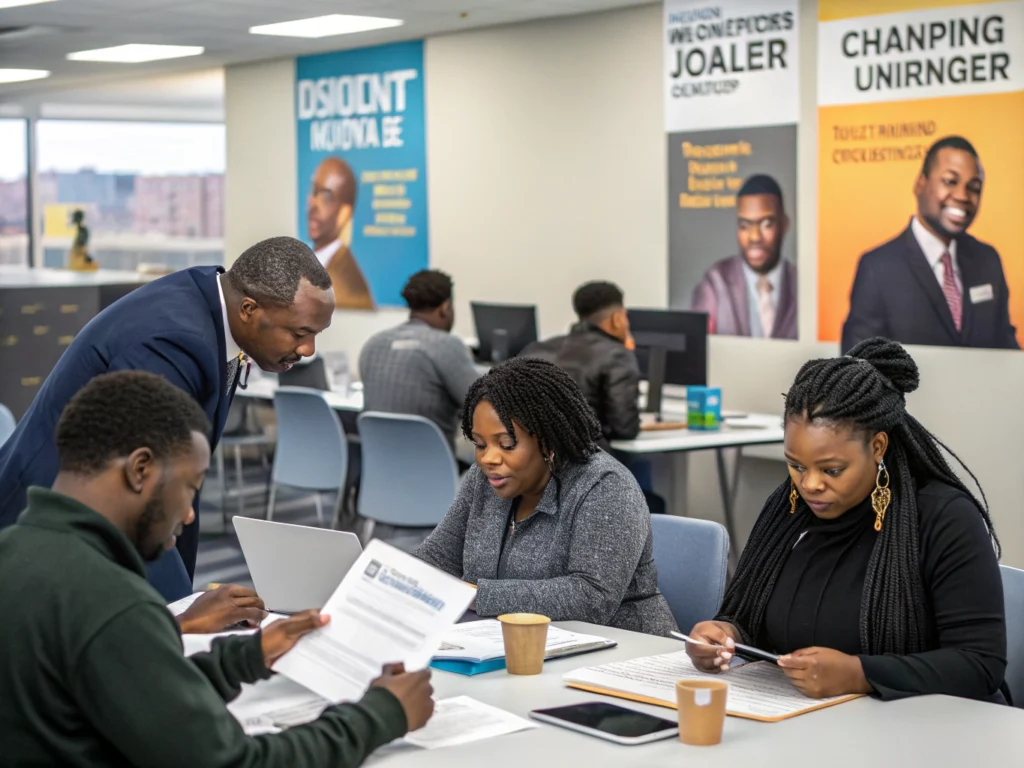
I’ve spent enough time around unemployment offices — first as a veteran figuring out my own next move, then as a journalist covering other people figuring out theirs — to recognize the specific quiet that comes over a room when people realize the job market changed while they weren’t looking. That quiet is spreading through Black America right now, and most of the country hasn’t noticed yet.
The numbers are not subtle. More than 155,000 roles have been eliminated due to AI adoption in just the first six months of 2026, and the layoffs are landing unevenly. When Amazon cut roughly 30,000 positions this year, Black employees held close to 20% of the eliminated roles while making up only about 13% of the company’s workforce. That’s not coincidence, and it’s not new — it’s the same math that’s driven every automation wave since the 1980s, just running at software speed instead of assembly-line speed.
Bureau of Labor Statistics data explain why. Black workers are overrepresented in clerical and administrative roles — the exact category of work large language models and automated workflow tools are built to replace first. It’s the low-hanging fruit of the AI transition, and Black professionals have disproportionately been standing under that tree.
What makes this moment more dangerous than past automation waves is what happens after the layoff notice. Research from the National Bureau of Economic Research found that workers displaced by automation see earnings losses of 20% to 30% that can last more than a decade, with the steepest losses concentrated among Black workers who don’t have access to retraining or a pipeline back into the workforce. And the cushion that’s supposed to absorb that shock isn’t there for most Black families the way it is for white ones. The Federal Reserve’s most recent Survey of Consumer Finances put median Black household wealth at $44,900, compared to $285,000 for white households. That gap was already brutal before AI started cutting into the job categories where Black workers are concentrated. Now it’s the gap deciding who can afford six months of retraining and who can’t afford six weeks of missed rent.
Here’s the part of this story that doesn’t get said enough in either direction: this isn’t a call to panic, and it isn’t a call to pretend it isn’t happening. I’m not interested in doom content, and I’m not interested in the tech-optimist version of this story either, the one where everybody just “learns to code” and it all works out. Both of those are lazy. The honest version is that this transition is already underway, it is landing harder on Black workers specifically because of where we’re concentrated in the labor market, and the only real defense is getting ahead of where the puck is going instead of waiting to see if it hits you.
That starts with representation inside the rooms building this technology, not just the rooms affected by it. Less than 5% of American AI professionals are Black. That’s not a diversity statistic to feel bad about — it’s a practical problem, because the people designing which tasks get automated and which get protected are making decisions that shape Black employment outcomes for the next twenty years, largely without Black people in the room. Every additional Black engineer, product manager, or policy voice inside an AI company is one more person asking “who does this actually affect” before the tool ships instead of after.
It also means treating AI fluency the way earlier generations treated computer literacy — not optional, not someday, now. I’d rather see a Black professional in an administrative or clerical role spend evenings this year learning how to use the AI tools that are coming for that role than wait for the layoff notice to start figuring it out. The workers who survive this transition aren’t necessarily the most talented ones. They’re the ones who moved from “AI does this instead of me” to “I’m the person who runs the AI” before their employer made that decision for them.
On the institutional side, this is exactly the kind of moment Black professional and fraternal organizations, HBCUs, and workforce development nonprofits should be treating as a five-alarm priority — not a webinar topic, an actual retraining infrastructure with real placement pipelines behind it. A handful of programs are starting to move in that direction. They need funding, visibility, and urgency far beyond where they currently sit.
None of this erases the injustice of a system where Black workers get automated out first and rehired last. That’s real, and it deserves to be named plainly instead of softened into corporate language about “workforce transformation.” But naming the injustice and building a personal and community response to it aren’t in tension — they have to happen together. I’ve watched too many crises get talked about extensively and prepared for barely. I don’t want AI displacement to be the next one.