Minority Mental Health Awareness Month comes around every July, and every July there’s a familiar rhythm to the coverage: sobering statistics, a call to “start the conversation,” maybe a hotline number at the bottom. I’ve written pieces in that rhythm myself, including one recently for this publication on why the crisis among Black men stayed invisible for so long. This year, something slightly different is happening alongside the usual awareness content, and it’s worth naming specifically because it’s the part that actually matters — infrastructure is starting to get built, not just conversations started.
The scale of the problem hasn’t changed, and it shouldn’t be softened. Deaths of despair — suicide, overdose, and alcohol-related deaths — nearly tripled among Black Americans between 2013 and 2022. Black adults are 36% less likely to receive mental health treatment than white adults despite reporting similar or higher rates of anxiety and depression. And the supply side of the problem is stark: just 4% of psychologists, 2% of psychiatrists, and 11% of licensed professional counselors in the country are Black. For a Black man in Milwaukee looking for a therapist who might actually understand his context without him having to explain it from scratch, the odds are not in his favor.
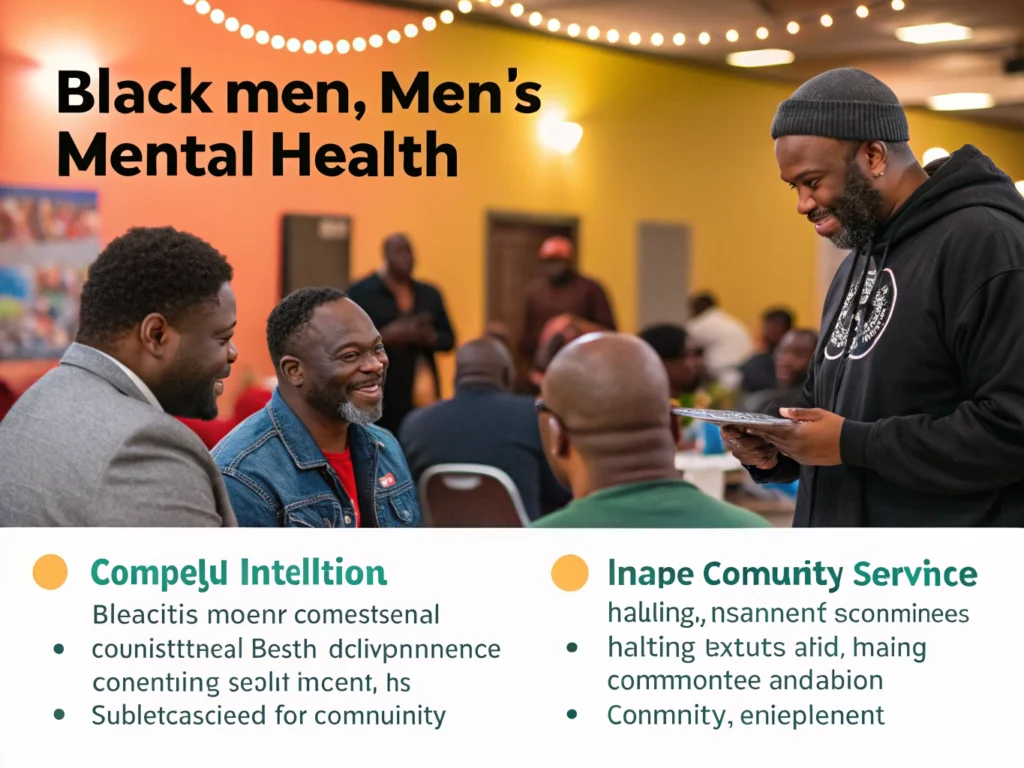
What’s changed this year is where the response is coming from. On July 11, First Neighborhood Place hosted a Black Men’s Mental Health Conference at Western Middle School, built around panel discussions and hands-on workshops covering addiction recovery, reentry after incarceration, vocational training, expungement assistance, and mental health services together — not mental health as a siloed topic but as one piece of a bigger picture that includes housing, employment, and legal status. Atlanta is hosting its own version of that conference later this month. These aren’t awareness events in the passive sense. They’re intake points, connecting men directly to services in the room instead of handing out a pamphlet and hoping.
The more structurally significant move is happening through the Jed Foundation, which has launched a partnership with Alpha Phi Alpha Fraternity, Inc. as part of its Greek-Letter Organizations program. I want to sit with why that partnership specifically matters, because it’s a smarter play than it might look like from the outside. Black men are less likely to walk into a therapist’s office cold, but they are far more likely to already be embedded in a structure with real trust, real accountability, and real peer relationships — a fraternity, a church, a veterans’ group, a barbershop crew. The Jed Foundation partnering with Alpha Phi Alpha isn’t about adding mental health as a topic at a chapter meeting. Done right, it’s about training the men who already have influence inside that structure to recognize crisis, have the conversation, and make the warm handoff to actual care instead of leaving a brother to sort it out alone. That’s a fundamentally different model than “raise awareness and hope people self-refer,” and it’s the model I’ve seen work in veteran spaces, where the guy who convinces you to get help is rarely a clinician — it’s the guy who was in your unit.
I say that from direct experience. I didn’t get help for what I was carrying after I got out because a poster told me to. I got help because someone who’d already been through it looked at me and said the thing plainly, without judgment, in a context where I couldn’t wave it off as easily as I could a stranger’s advice. That’s the piece the field has been slow to build systematically — not more awareness campaigns aimed at the men themselves, but investment in the people already inside their trust networks.
None of this solves the provider shortage, and it shouldn’t be mistaken for solving it. Peer support and community infrastructure are not a substitute for actual clinical care when clinical care is needed, and the 4%-of-psychologists number remains a real structural failure that requires real structural fixes — more funding for Black students in psychology and psychiatry programs, more loan forgiveness tied to underserved-community service, more investment in training pipelines at HBCUs specifically. Community infrastructure and clinical capacity have to grow together, or the peer networks will keep referring men to a system that doesn’t have room for them.
But I’d rather write about what’s being built than keep repeating the same statistics with a new coat of paint every July. A frat brother trained to recognize a crisis conversation and make the handoff, a reentry-focused conference that treats mental health as inseparable from housing and employment, a First Neighborhood Place event that connects men to services in the same room instead of a follow-up email nobody sends — that’s what solution-first coverage of this crisis should look like going forward. The statistics got us to pay attention. The infrastructure is what’s actually going to move them.