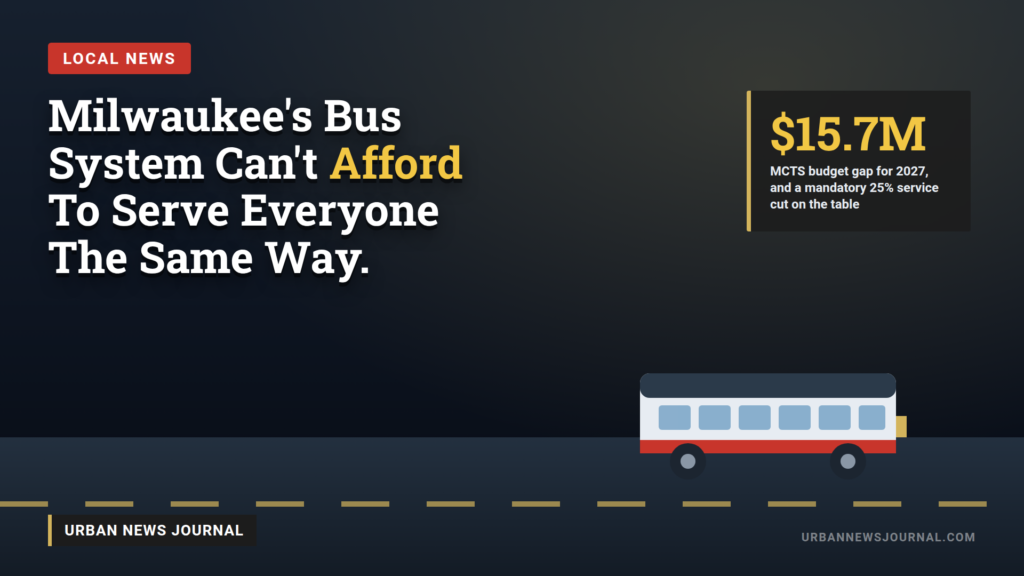
Milwaukee County Transit System is staring down a $15.7 million budget gap for 2027, and the two fixes it put forward this month both mean less bus for somebody. The real question isn’t whether MCTS cuts service. It’s who absorbs the cut.
State transit funding has been frozen for years while every operating cost around it, fuel, parts, driver wages, kept climbing. That gap finally caught up to Milwaukee County Transit System this year, and the number is $15.7 million for 2027 alone. MCTS is now planning around a mandatory 25 percent service cut, and it put two competing redesign concepts on the table for public reaction before anything gets finalized.
Neither one is a small adjustment. Both reshape how tens of thousands of Milwaukee residents, people who ride the bus to work, to dialysis, to school, because they don’t have another way to get there, actually get around the county.
The two options
Concept one, the ridership model, consolidates the system hard. Routes drop from 44 down to 21, but the routes that survive run every 15 minutes instead of the current patchwork of schedules. Fifty-one percent of riders would end up near a high-frequency stop. Access to jobs barely moves under this model, only a 2 percent drop county-wide. But 30 percent of current riders would end up more than half a mile from any stop at all, a distance that matters a lot more in February than it does on a mild afternoon.
Concept two, the coverage model, protects geography instead of frequency. It keeps 43 of the current 44 routes intact, meaning nearly every existing stop stays where it is. The tradeoff is wait time: buses would come every 30 to 60 minutes instead of the current frequency. Almost everyone stays within walking distance of a stop, but only 18 percent of riders would get fast, frequent service, and job access takes a much bigger hit, a 37 percent drop.
Read those two numbers against each other and the shape of the decision gets clear fast. One plan protects whether a bus comes near you at all. The other protects how often it comes once you’re there. MCTS says it can’t afford to give riders both right now, not without new funding nobody has committed to yet.
Who actually rides the 30-to-60-minute wait
This isn’t an abstract transit-planning exercise. Milwaukee’s bus system disproportionately serves people with the fewest transportation alternatives: elderly riders, disabled riders, and workers whose jobs are far enough from home that Uber isn’t a realistic daily option. Under the coverage concept, those are the riders who’d be budgeting an extra 30 to 60 minutes into a bus stop, in a city where winter isn’t optional and a missed transfer can mean a missed shift.
Whichever plan the county lands on, the job-access numbers say something uncomfortable out loud: a service designed to help people reach work is set to make reaching work measurably harder for a meaningful share of the people who depend on it. A 37 percent drop in job accessibility under one concept, a 2 percent drop under the other, is not a rounding error. It’s the actual tradeoff being negotiated on the county’s behalf.
What’s actually being decided, and by whom
MCTS has framed this as a public-input process, and there’s a live survey open right now through MCTS Forward for riders and their families to weigh in on before the county commits to either concept. That input matters more than usual here, because the honest version of this story isn’t “the bus service is bad.” It’s a funding shortfall with two different ways of distributing the pain, and a public agency asking residents to help decide which neighborhoods get the shorter end.
It’s also, inescapably, an accountability story. Wisconsin’s next governor will inherit responsibility for how the state funds public transit statewide, and Milwaukee County’s own executive, David Crowley, is on the ballot for that job this November while his own county’s transit system runs a $15.7 million hole. Whoever wins in November will be making budget decisions that determine whether Milwaukee ever gets out of the position of choosing between “the bus comes near you” and “the bus comes on time.”
If you ride the bus, or if someone in your family does, the survey is open now, not after the county has already picked a direction. Urban News Journal will track which concept moves forward and report on the vote when the county makes it.
Have a story about how a route change would affect you, your commute, or your job? Reach us at press@marcus-hart.com. We want to hear from riders directly, not just read the county’s own numbers back to you.