This is the companion report to the Urban News Journal episode recorded live on Veterans Day, Tuesday, November 11, 2026. Every figure below is sourced, and corrections to our own prior reporting appear at the end.
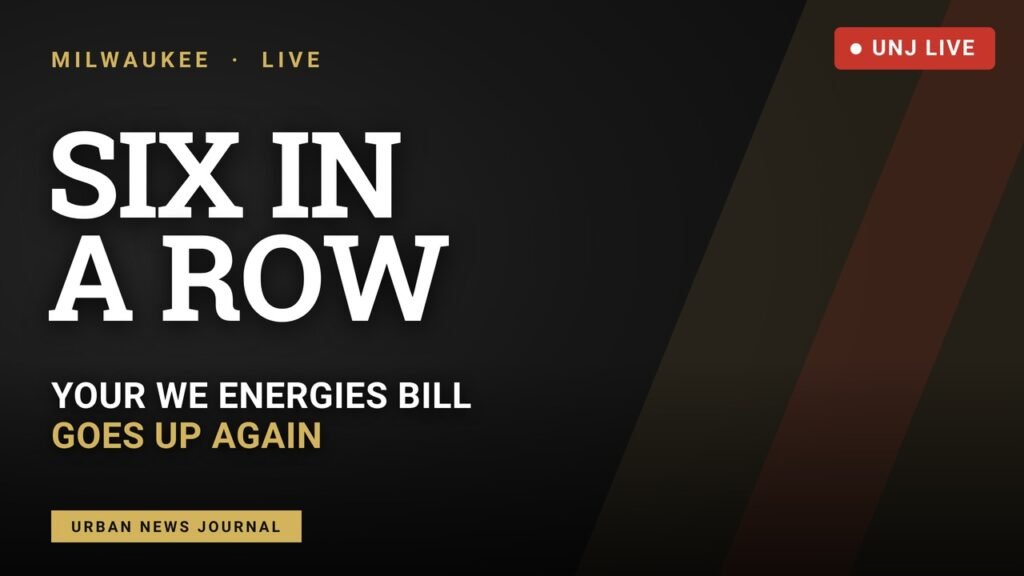
Your light bill goes up for the sixth time in a row. Milwaukee just borrowed money to study buying the utility.
The Public Service Commission of Wisconsin approved another rate increase for We Energies. Base electric rates rise 3.9 percent in 2027 and 3.5 percent in 2028. Milwaukee Neighborhood News Service puts the combined effect at roughly 7 percent across the two years, and calls it the sixth consecutive rate hike.
Here is what that means at your kitchen table. WEC Energy Group’s own estimate is 7 to 8 dollars more a month in 2027, and another 6 to 7 dollars a month in 2028. Call it 14 or 15 dollars a month by the end of 2028 against what you pay right now.
Now the part that deserves credit, because this newsroom is not in the business of telling you everything is a disaster.
Regulators gave the company less than it asked for. We Energies wanted 4.6 percent and 4.5 percent. It wanted a 9.9 percent return on equity, which is the guaranteed profit margin regulators allow a utility to earn. The commission set it at 9.5. Tom Content, who runs the Citizens Utility Board, says that one decision saves ratepayers roughly 60 million dollars over the next two years.
Content’s read: “They did some things that the PSC has been reluctant to do in the past in the name of affordability.” And then: “they could’ve gone even further.”
Across the whole request, the company initially proposed something near a 9 percent overall increase, including a 16 percent hike for residential customers. Content put the full ask at 449 million dollars over two years. A lot got cut.
Why is this happening at all? Two answers, depending on who you ask. The utility’s answer is construction. Milwaukee NNS reports most of the new revenue goes toward renewable energy, natural gas and battery storage projects, after the company raised capital spending by roughly 10 billion dollars over five years. The other answer is data centers. Urban Milwaukee reports utilities across this state are building for an expected 40 percent spike in energy demand by 2032.
Commissioners did something about that, and it deserves to be said plainly: they ordered that power plant construction costs for new data center customers be assigned directly to those customers. We Energies spokesman Brendan Conway said the approval ensures no costs to serve data centers are shifted to other customers.
On paper, that is the right call. The question nobody has answered is enforcement. Who checks the math on which costs got assigned where, and when does the public get to see it? The commission has not issued its written order yet. The final rates are a few weeks out. That is the document to read.
Two commissioners said things worth repeating. Kristy Nieto: “we have to ask whether the scales are properly balanced.” Marcus Hawkins: “We need to deny something.” Those are regulators saying out loud that the pattern of approval is the problem.
And the pushback is not only coming from households. Walmart opposed the return on equity request as unjustified. A small business owner named Lisa Geason-Bauer testified against the hike. When a national retailer and a small business owner sit in the same hearing room telling you the number is too high, that is not a partisan complaint. That is arithmetic.
The Milwaukee angle is the real story underneath the story. The Milwaukee Common Council voted unanimously to allow borrowing of up to 1.35 million dollars for a feasibility study on the city taking over We Energies. Milwaukee NNS reports the borrowing still hinges on Mayor Cavalier Johnson’s approval.
A study is not a takeover. Nobody should leave this page thinking the city is about to run your power. But a unanimous council vote to spend that money after six straight increases tells you where the frustration level sits.
Urban News Journal is putting two questions to the mayor’s office in writing this week. What is the timeline on signing off? And when the study comes back, does the public see the whole thing or a summary? A 1.35 million dollar study that lands as a four page executive summary is not accountability. It is a receipt.
If your bill is already the thing you move around to make the month work, 14 dollars is not a rounding error. Write the Public Service Commission before that written order lands. It is the only window where your comment is on the record for the final rates.
219 million dollars of Meta’s money is sitting in Wisconsin. One person decides where it goes, and the clock runs out in January.
In August, Attorney General Josh Kaul announced that Wisconsin will receive at least 219 million dollars over ten years from a multi-state settlement with Meta. Forty seven states were party to it. Kaul called it the largest Big Tech settlement in the history of the country. Reporting at the time from the Associated Press put the national figure at 17 billion dollars and said Wisconsin’s share could reach up to 313 million if other social media companies meet certain conditions.
The states alleged Meta deliberately designed features to addict children, hid that from the public, and contributed to the youth mental health crisis. They also alleged Meta collected data on children under 13 without parental consent, in violation of federal law.
That is money a company paid because of what it did to kids. Nobody has decided where it goes.
Milwaukee Neighborhood News Service published a piece by Alex Klaus on Tuesday with the detail that makes this urgent. Under a state Supreme Court ruling from July, the allocation decision sits with the attorney general, not the Legislature. Kaul, who kept his seat this month, says the Department of Justice is actively evaluating how to allocate it: “We’re just not at the point yet where we’ve made final determination as to precisely where all of the dollars will be going.”
And from the same reporting: money not allocated by January gets used at Kaul’s discretion. That is seven weeks.
At least half the money has to target youth mental health and social media harms. After-school programs are an allowed use. The Wisconsin Partnership for Kids is asking for 10 million a year to go directly to after-school programs, plus 20 percent of each year’s money placed in an endowment so the funding does not evaporate when the ten years run out. Organizer Jackie Scott says people treat after-school programs as “extra, as fluff, when really it can be the antidote to a lot of what ails us.”
Here is the Milwaukee address on this. Safe Place, at Gwen T. Jackson School, is run by Neu-Life Community Development. When something terrible happens in a child’s life, that program lets the child sit down with a Milwaukee County social worker, right there at school.
It has no dedicated state funding.
Executive director Jody Rhodes: “Now we’re very proactive in offering support and resources for the kids and families because we know how hard it is to navigate tragedy or something traumatic.” And then the line that explains how this actually gets paid for: “It’s a constant hustle to keep all our kids served.”
The Boys and Girls Clubs of Greater Milwaukee runs 42 Community Learning Centers plus after-school programming inside MPS. That reporting notes their federal grant funding was cut 14 percent after roughly 15 years of flat funding.
One number to hold onto. The state Office of Children’s Mental Health reported that the share of Wisconsin high school students who feel they belong at school fell from 73.7 percent in 2013 to 53.6 percent in 2023. Fewer than half of girls, Hispanic students, Black students and LGBT students say they feel like they belong. From three quarters to barely half, in ten years.
The window when children are least supervised and most likely to be on a phone is 3 to 6 in the afternoon. That is exactly the window an after-school program covers.
So the failure here is not complicated. Meta paid because of what its product design did to children. Wisconsin’s share is at least 219 million dollars. One person decides where it goes. There is no public allocation process on the record that we can find, no published criteria, and a January default that hands unallocated money to that person’s discretion. Meanwhile a Milwaukee program that puts a county social worker in front of a grieving child runs on a constant hustle with no dedicated state line.
That is not a tragedy. It is a decision that has not been made yet, and the people it affects most are not in the room.
Urban News Journal is filing a records request with the Department of Justice this week for the allocation criteria and any internal memos on how the 219 million gets distributed. We will report what comes back, whatever it says.
Day 44: three public offices have never answered a single question
On September 28, Urban News Journal mailed seven certified letters with return receipts from the post office on Greenfield Avenue in West Allis. The cost was 77 dollars and 14 cents, paid personally. Seven public offices, one question: produce the after-action report on the disturbances at the closing of the 2026 Wisconsin State Fair. Fifteen business days.
That deadline expired on October 19. There is no countdown clock anymore. What runs now is a count of days of silence, and today it is 44.
Where things stand, documented:
- West Allis Police answered October 7, in writing. They assisted State Fair Police, made no arrests, and hold no after-action report, no staffing records and no access control records.
- The West Allis mayor and two alderpersons answered October 16, through Amy Grau in their marketing and engagement office. They have no records and no control over State Fair Park’s security or reporting.
- Wisconsin State Fair Park acknowledged a separate, general records request on October 6 and has produced one document.
- The Governor’s office, the Milwaukee County Executive’s office, and the Wisconsin Attorney General’s Office of Open Government have never responded at all. Forty four days, three offices, zero words. The Office of Open Government’s job is public records compliance in this state.
The one document State Fair Park produced is the State Fair Park Police Department booking log for August 2026. It is not the after-action report. The after-action report is still the request.
The log is a handwritten paper form. That is its own story. In 2026, a state agency’s booking record for a fair that draws a million people is a page somebody filled in with a pen.
What is on it is a gap between what the agency said publicly in August about closing night and what its own August log accounts for.
Urban News Journal reports this in aggregate only. No names, no dates of birth, no individual identifying details, here or on air or in any clip. These are private people, a booking record does not establish that anyone did anything, and we will not put a stranger’s name in public off a handwritten page.
Four ordinary explanations for that gap have not been ruled out, and readers deserve them up front. One, the log may be the adult record, with juveniles kept separately and not appearing on it at all. Two, another agency may have acted, though West Allis Police stated in writing that it did not. Three, the language an agency uses in a press statement does not always map onto the terms in its records system. Four, the page is marked “Page __ of __” with the field left blank, so it may simply be incomplete.
This is not a report of a cover-up. It is a report of a gap, and the document that would explain it is the one three offices will not discuss.
What is new: State Fair Park’s stated position is that releasing the after-action report, or the 2027 safety plan, would endanger the public by exposing their security plans. That is the first actual reason any of the seven offices has given for withholding anything.
It is not a frivolous argument. Wisconsin’s public records law does include a balancing test, and the security of a public venue is a real thing to weigh. But it does not hold all the way. An after-action report is a backward-looking document. It says what happened and what went wrong. Agencies across this country release them with operational details redacted. Redaction is the tool that exists for exactly this situation. You do not withhold an entire document because part of it is sensitive. You black out the sensitive part and hand over the rest. And the 2027 safety plan is a different question from the after-action report. Both have been answered as though they are the same question.
Four follow-up requests are now on the record: every page of the August log with the page count filled in; an aggregate count of juveniles taken into custody on August 16, no names; which agency was responsible that night; and the after-action report, redacted if it has to be.
One housekeeping item about our own paperwork. The 2026 fair ran August 6 through 16, and the disturbances were Sunday evening, August 16, before the 10 o’clock close. FOX6 published the next day, August 17, and the Fair’s statement came about 18 hours after that. Urban News Journal has been saying August 17. If our certified letters asked these offices about an incident on August 17, two of those “no records” answers may be technically correct, and the requests may need to be re-served with the correct date. We are pulling our own letter copies and checking before saying another word about it.
The 61 percent: what Veterans Day does not post about
Of the veterans who died by suicide in 2023, 61 percent were not in VA care. Not waiting on an appointment. Not in the system at all.
So when someone says the answer is that the VA needs to do better, they are describing a solution that would not have reached six out of every ten people in that number. You cannot improve a service for someone who never walks in the door.
The VA’s own response to this is a grant program named for Staff Sergeant Parker Gordon Fox. It exists to put money in the hands of community organizations rather than clinics, on the logic that the group already standing in front of that veteran, at the church, at the job, at the AA meeting, is the one with a chance. Nationally the program runs about 112 million dollars across roughly 191 groups.
Wisconsin’s share is about 1.8 million dollars, to three organizations. Westcare Wisconsin received 750,000 dollars. The Center for Veterans Issues, in Milwaukee, received 375,000 dollars.
Wisconsin has somewhere north of 300,000 veterans. Roughly 1.8 million dollars across three organizations, in a state that size, is not a program. It is a pilot. And it is the main federal tool aimed at the 61 percent who are not in the system.
Name the gap precisely, because vagueness is how this stays unfixed. We fund veteran mental health through the VA’s clinical system, and the people most likely to die are the ones furthest from that system. The bridge meant to reach them is community grant funding of a few hundred thousand dollars per organization on multi-year awards, which does not sustain a staff position long enough for a veteran to build trust with a specific person. That is the failure. Not stigma. Not awareness. Funding structure. We built the front door beautifully and most people never come up the walk.
There is a second piece. Wisconsin’s own Secretary of Veterans Affairs is retiring, which means the state agency that would advocate for closing that gap is heading into a transition. Whoever the next governor appoints inherits this arithmetic. That is a real appointment with real stakes, and it will get about four lines of coverage.
If today landed wrong on you, there is a local number with people in this area who answer it.
NAMI Southeast Wisconsin: 262-524-8886. That is a local organization, not a national switchboard, and they do training and family support as well, which matters if the person you are worried about is not you.
If what you need is practical, rent, a utility shutoff, food, which is very often what sits underneath it, dial 2-1-1. IMPACT 211 is free, local and answers around the clock.
Corrections
Urban News Journal corrects its own record on air and in print, every time.
Correction 1. In the November 9 episode, we reported the Milwaukee County budget error as 5.56 million dollars. The correct figure is 4.56 million dollars. The figure was stated correctly later in that same episode. A spoken correction in the November 11 episode repeated the incorrect number before landing on the right one, so to be unambiguous in writing: the Milwaukee County 2027 budget error is 4.56 million dollars.
Correction 2. At the close of the November 9 episode, the line in our faith segment was inverted on air. It was delivered as “everybody is not a steward.” The line is that everybody is a steward, and not one of us is an owner.
Correction 3. In the November 10 episode, we reported that Article Five of the impeachment resolution alleges at least 221 deaths from the boat strikes. That number is wrong. The resolution filed on November 9 alleges at least 243 deaths since September 2025. The 221 figure came from an earlier draft circulated in September. We were describing what a document says and described the wrong version of it.
That November 10 episode also said the House vote was still pending, which was accurate when it was recorded. The House voted a few hours after it published, 211 to 204, to send all eight articles to committee. Massie was the only Republican to vote against his own party on that motion. We covered the result in full at the top of the November 11 episode, and we are not pulling the earlier segment. Reporting on a vote before it happens is not a mistake. It is the job. What we owe you is that the reporting was accurate when we made it, and that we come back and tell you what happened.
Got a tip? Urban News Journal takes news tips from anyone in Milwaukee: reporting, writing, photos, or something you caught on the street. Email press@marcus-hart.com.
The newsletter is free and goes out twice a week. Subscribe here and get this before anyone else does.
New episodes Monday, Wednesday and Friday at 9:00 AM Central. Independent. Objective. Unafraid.
Sources
- Urban Milwaukee / Wisconsin Public Radio, “Regulators Scale Back Rate Hikes for We Energies, Wisconsin Public Service,” November 8, 2026
- Milwaukee Neighborhood News Service, Paul Kiefer, on the We Energies rate decision and the Common Council borrowing, November 10, 2026
- Milwaukee Neighborhood News Service, Alex Klaus, “After-school programs could see new funds as a result of social media lawsuit,” November 10, 2026
- Associated Press via Wisconsin Watch, on the Meta settlement, August 26, 2026
- Stars and Stripes, on the November 10 House vote, November 10, 2026
- CBS News, on the eight articles of impeachment
- U.S. Department of Veterans Affairs, Milwaukee, on the Staff Sergeant Parker Gordon Fox grant program
- Urban News Journal’s own certified mail receipts and agency correspondence, September 28 through November 11, 2026