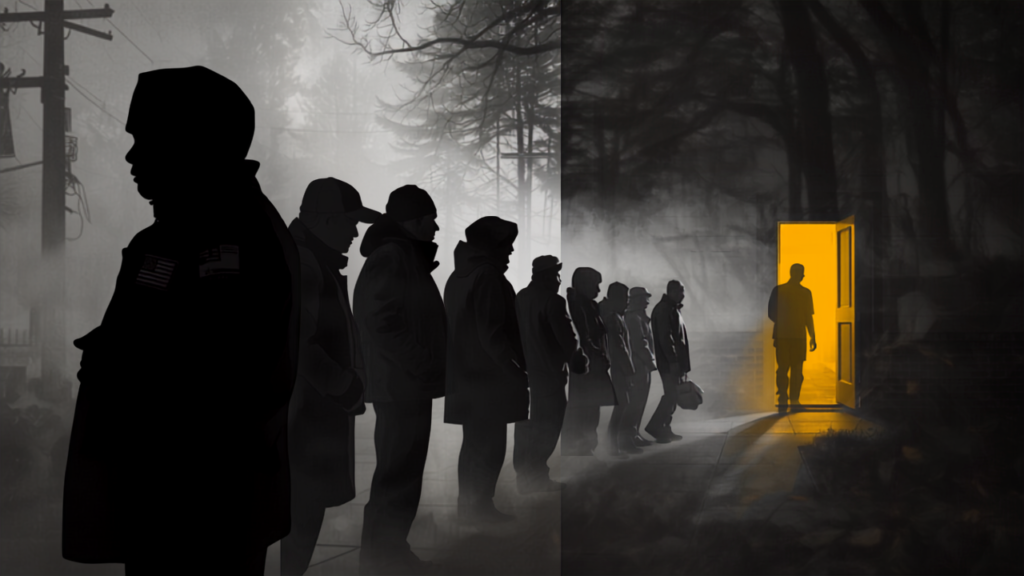
There’s a number out of my own backyard this month that deserves more attention than it’s getting: Veterans Outreach of Wisconsin’s food pantry has gone from serving roughly 150 veterans and their families a week to nearly 400. That’s not a modest uptick. That’s a two-and-a-half-times increase, in one of the more economically stable metro areas in the Midwest, among a population, veterans, that the country claims, loudly and often, to prioritize.
I want to sit with that number for a second before I get into the policy analysis, because I think we skip past numbers like this too fast. Four hundred veterans and their families a week is not an abstraction to me. I did four years active duty and carried the transition home like a lot of veterans do, imperfectly, with more support than some and less than others. I know what it costs a man or woman who served this country to walk into a pantry line and ask for groceries. It’s not just an economic transaction. For a lot of veterans, especially men who were trained to see asking for help as a failure of self-reliance, it’s one of the harder things they’ll do after leaving the service. When that number triples in a place like Milwaukee, it’s not because veterans suddenly became less capable of managing their households. It’s because the ground shifted under them, cost of living, VA benefit processing delays, housing costs, the slow erosion of the kind of stable working-class jobs that used to make a post-service transition survivable without needing an emergency food pantry.
Locally, this connects directly to a story I covered here recently about Wisconsin’s prisons running roughly 5,000 people over capacity, with Milwaukee absorbing much of the downstream impact. These aren’t separate crises. Veterans are overrepresented in the justice system relative to their share of the population, particularly veterans dealing with untreated PTSD, substance use, or housing instability, the exact conditions that also drive someone toward a food pantry line. When I look at Milwaukee right now, I see a city where several different safety-net failures are compounding on the same population at the same time: strained mental health infrastructure, an overcrowded justice system, and now a documented, sharp rise in veteran food insecurity. That’s not five unrelated headlines. That’s one crisis wearing different hats depending on which system a veteran happens to touch first.
I’ll say something that might not sit comfortably with people who want this to be a simple story about honoring veterans with a flag and a “thank you for your service.” Gratitude language is cheap, and I’ve grown genuinely tired of watching it substitute for material support. Milwaukee, and Wisconsin more broadly, has real veteran service infrastructure, the VA Milwaukee health system, organizations like Veterans Outreach of Wisconsin doing the actual daily work, but infrastructure built for a baseline level of need doesn’t hold up when demand nearly triples without a matching increase in resources or staffing. That’s not a knock on the organizations doing this work; if anything, it’s a testament to them that they’re absorbing this surge instead of turning people away. It’s a warning about what happens when public attention to veteran welfare cycles in and out with news events instead of staying consistent.
Here’s where I want to be specific about solutions, because pointing at a problem without one is easy and doesn’t help anybody standing in that pantry line. First, this is a data story before it’s anything else, Veterans Outreach of Wisconsin and similar organizations need consistent, published demand tracking that local media and lawmakers actually use to trigger funding responses, not just annual reports that get filed and forgotten. Second, county and state veteran service offices should be doing more active outreach specifically flagging households at risk before they hit a pantry line, using VA benefit processing data and unemployment claims as early indicators rather than waiting for the crisis to show up as a line out the door. Third, and this is where I’d ask readers directly to do something rather than just feel something, if you’re in the Milwaukee area and in a position to give, Veterans Outreach of Wisconsin is the organization actually doing this work right now, this week, with real capacity strain. Time and donations matter more this month than they did six months ago, and that’s worth knowing.
I’ll keep tracking this number. If it’s still climbing by the time we get to fall, that tells us something about whether this was a temporary economic pressure or the start of something structural. Either way, a veteran food pantry line tripling in a city like Milwaukee isn’t a local human-interest story. It’s a preview of what happens nationally when the support systems built for veterans stop scaling with the actual need. We should all want to know the answer before it gets worse, not after.