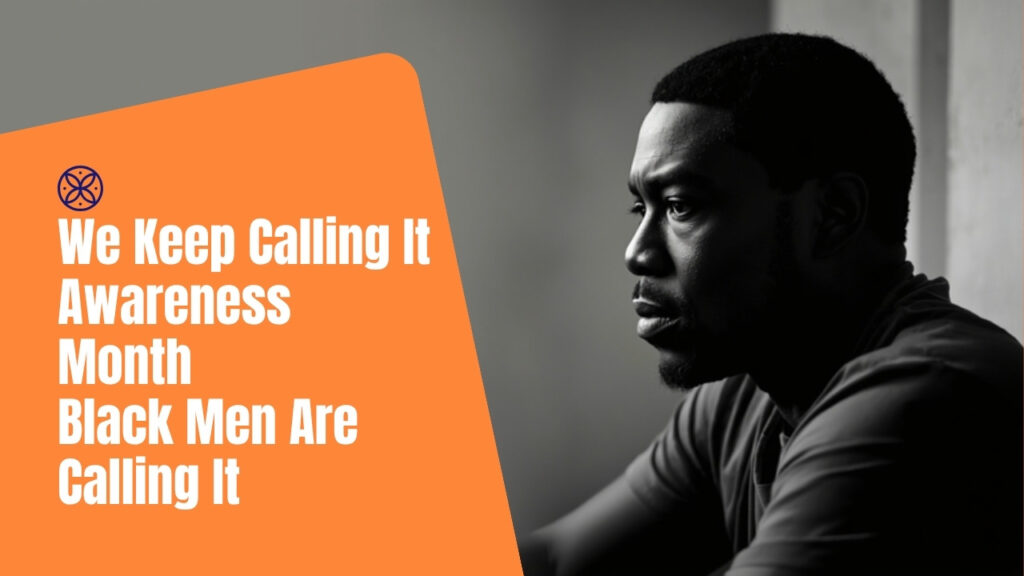
July is National Minority Mental Health Awareness Month, and if you’ve spent any time in Black media this month, you’ve seen the conferences, the panels, the hashtags. Louisville held one. Atlanta held one. Baltimore held listening sessions. All of it matters. None of it is enough.
Here’s the number that should stop you: according to the National Institute of Mental Health, Black men die by suicide at rates significantly higher than Black women, and recent trends show what researchers are calling an alarming, unprecedented surge specifically among young Black males. Not a plateau. Not a slow climb. A surge, among the youngest men in our community, at the exact moment we’re holding more panels about it than ever before.
I want to be honest about what that gap means, because it’s not a coincidence and it’s not just “awareness lagging behind reality.” It means the thing we’re building — the conferences, the commentary, the Instagram infographics every July — isn’t reaching the people who are actually in danger. Awareness campaigns are built for people who are already looking for help. The surge is happening among men who aren’t looking, who won’t look, who’ve been taught by every institution in their life that looking is the failure.
I’ve written before about my own path — combat veteran to journalist to founder — because I don’t think you can talk credibly about Black men and mental health without admitting you’ve stood inside the wreckage yourself. I know what it is to come home from something and have every voice around you, including your own, insist that the strong move is silence. Nobody hands you a manual for what to do when the silence stops working. Most men find out it’s stopped working at the worst possible moment.
The commentary circulating this month names three real barriers, and they’re worth taking seriously instead of treating as background noise. First, cultural expectations around masculinity — the idea, still alive in barbershops and locker rooms and family reunions, that needing help is a character defect rather than a normal human response to abnormal pressure. Second, mistrust of mental health systems, which isn’t paranoia — it’s institutional memory. Tuskegee didn’t happen to strangers. Misdiagnosis, over-medication, and dismissive treatment in clinical settings are documented, recent, and remembered. Third, a genuine shortage of Black providers, which means even a man who overcomes the first two barriers often ends up explaining his life to someone who has never had to live inside it.
You don’t solve three structural barriers with a hashtag. You solve them with specific, unglamorous work, and here’s where I want to depart from the awareness-month script and get concrete, because solution-first has to mean something or it’s just another slogan.
Faith communities are underused infrastructure here, and I say that as someone who holds faith as a lens, not a wall. Black churches already have the trust, the physical space, and the standing relationships that clinical systems spend years and grant money trying to build. A men’s ministry that trains lay leaders to recognize crisis signs and make a warm handoff to a licensed counselor isn’t a replacement for treatment — it’s the on-ramp that gets a man to treatment before the surge statistic claims him. That model exists in pieces around the country. It needs to exist at scale, and pastors need to stop treating mental health as a subject outside their lane.
Veterans’ organizations need to stop running mental health programming as a separate track from Black-men’s mental health programming, because for a huge share of Black veterans, those are the same conversation wearing two different name tags. The VA has resources. Many Black veterans don’t trust the VA to understand them, which loops right back to barrier two.
And employers — particularly in industries with heavy Black male workforces, from logistics to public safety to trades — need Employee Assistance Programs that are actually marketed by people who look like the workforce, not buried in an HR packet nobody reads. An EAP nobody trusts is an EAP that doesn’t exist.
None of this is complicated in concept. It’s just slow, unglamorous, and doesn’t generate a viral panel photo. But the surge NIMH is reporting isn’t going to be solved by better awareness. It’s going to be solved by better access, delivered through channels Black men already trust — and right now, in July 2026, we still have more awareness than access. That gap is where men are dying. Close it, and the conference becomes unnecessary. That should be the actual goal.